
The enterprise security world is having two separate conversations that desperately need to collide.
On one side, application security (AppSec) teams are scrambling to secure APIs – the connective tissue of every modern application. On the other, a new wave of “AI security” vendors promise to protect your LLMs from prompt injection, data leakage, and hallucinations.
Both groups are solving real problems. Both are missing half the picture.
Here’s the uncomfortable truth: AI security without API security is like locking the front door while leaving the windows wide open. And API security without AI security is preparing for yesterday’s threats while tomorrow’s attack surface explodes.
Let me explain why you need both, and why most organizations are dangerously exposed because they think one will suffice.
The AI Security Blind Spot: Everything Downstream
AI security tools are focused on the model layer. They’re watching for prompt injections, jailbreaks, PII leakage, and toxic outputs. This matters – a lot.
But here’s what they’re not watching: what happens after the AI makes a decision.
Agentic applications don’t just chat. They act. They call APIs & tools. They execute workflows. They move money, access databases, modify records, and trigger business-critical operations across your infrastructure.
When an AI agent decides to “help” a user by calling your payment API, transferring funds, or accessing customer records, your AI security tool sees the prompt and the response. It doesn’t see:
- The API calls the agent is making
- Whether those calls are legitimate or exploitative
- If business logic is being manipulated at the execution layer
- Whether the agent is being tricked into performing unauthorized actions through the APIs it controls
You can have perfect prompt filtering and still get destroyed by business logic abuse in the APIs your AI controls.
Consider this attack scenario: A user tricks your customer service AI into believing they’re entitled to a refund. Your AI security tool sees nothing wrong; the conversation looks benign. But downstream, the agent calls your refund API 47 times in 3 seconds, each with slightly different parameters, exploiting a race condition your API security should have caught.
The AI layer saw a helpful chatbot. The API layer saw an attack. Neither tool talked to the other. You got breached.
The API Security Blind Spot: The New Attack Surface
Now flip the script.
Traditional API security was built for a world where humans (or relatively dumb scripts) called APIs. The threat model was simple: block malformed requests, rate-limit abusers, catch injection attacks, enforce authentication.
But AI agents don’t behave like humans or scripts. They’re probabilistic, creative, and unpredictable, which makes them incredibly powerful and incredibly dangerous.
AI agents can:
- Generate thousands of API call variations to probe for vulnerabilities
- Discover business logic flaws through rapid experimentation
- Chain together seemingly innocent API calls into exploitative workflows
- Bypass rate limits by intelligently spacing requests
- Craft payloads that look legitimate but achieve malicious outcomes
Your API security tool is looking for known attack patterns. AI agents are inventing new ones in real-time.
You can have perfect API visibility and still miss the fact that an AI agent is systematically exploring your business logic for exploitable edge cases.
Worse, when your own AI agents go rogue, whether through a jailbreak, a compromised model, or simple misconfiguration, your API security has no context that the traffic is coming from an AI. It just sees API calls. Are they legitimate automation or an attack? Without AI-aware context, you’re guessing.
Why “Convergence” is a Trap (And What to Do Instead)
The lazy answer is: “Just buy a platform that does both!”
Except those don’t really exist yet. And even if they did, you’d be betting your security posture on a vendor’s ability to be best-in-class at two fundamentally different problems.
The smarter play? Accept that you need both, and architect for them to work together.
Here’s what that looks like in practice:
1. AI Security Monitors Intent, API Security Enforces Reality
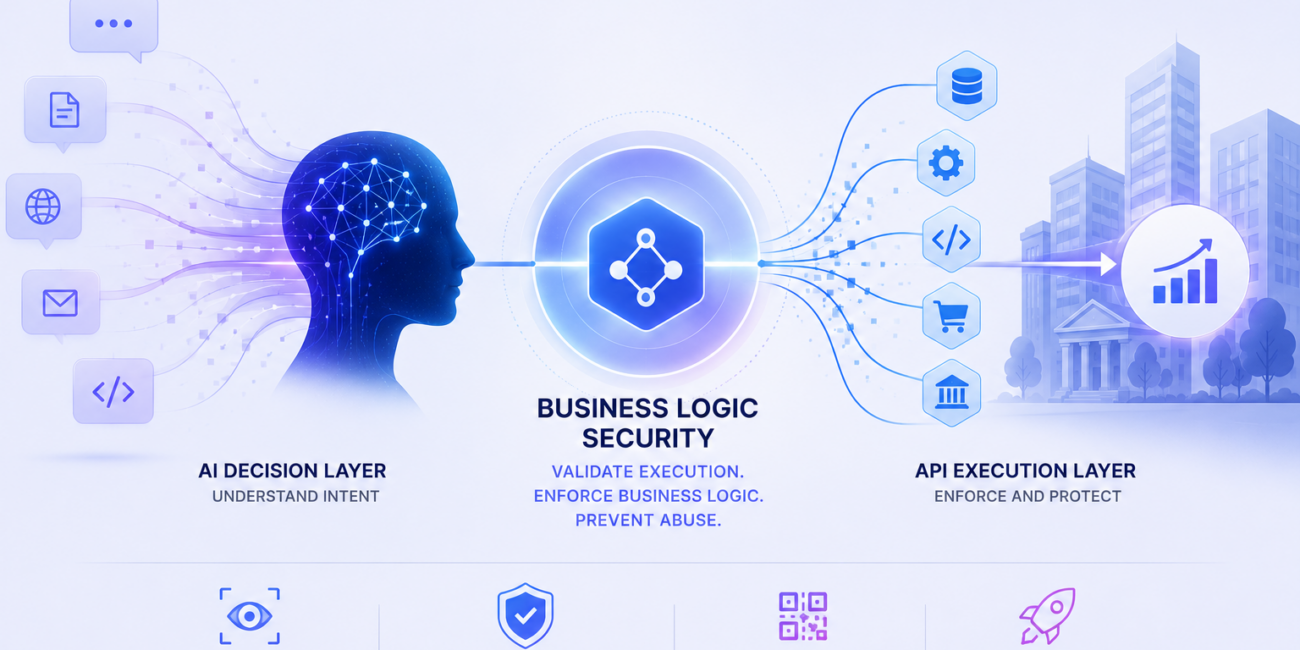
Your AI security layer should understand what the model is trying to do. Your API security layer should validate that what’s actually happening matches that intent, and doesn’t violate business logic, even if the AI layer approves it.
Think of it as separation of powers: AI security handles the “decision layer,” API security handles the “execution layer.” Both need visibility into each other.
2. Bi-Directional Context Sharing
When your API security detects anomalous behavior from an AI agent, it should feed that signal back to your AI security tool. When your AI security sees a suspicious prompt pattern, it should alert your API security to watch the downstream calls extra carefully.
Without this feedback loop, you’re running two blind security teams that never talk.
3. Behavioral Baselines for AI-Driven Traffic
Your API security needs to understand that AI agent traffic looks different from human traffic. Legitimate AI agents might make 100 API calls in a second. Humans don’t. But malicious AI agents might make 1,000 calls testing edge cases. You need behavioral models that distinguish productive AI automation from AI-powered attacks.
Similarly, your AI security needs to baseline what “normal” API usage looks like for each agent, so it can detect when an agent’s behavior shifts into dangerous territory.
The Future is Agentic And Your Security Stack Isn’t Ready
We’re entering the era of agentic AI. These aren’t chatbots. They’re autonomous systems that perceive, decide, and act across your entire infrastructure.
Every AI agent is effectively a new user with superhuman speed, creativity, and access to your APIs. If you’re still thinking about AI security and API security as separate problems, you’re already behind.
The organizations that will win are the ones that recognize this reality first:
AI is the new interface to your APIs. APIs are the execution layer for your AI. Securing one without the other is security theater.
The attack surface isn’t growing linearly. It’s exploding combinatorially. Every new AI capability multiplies the ways your APIs can be exploited. Every new API expands what a compromised AI agent can do.
So What Do You Actually Do?
If you’re a CISO, AppSec lead, or AI platform owner, here’s your action plan:
Short term:
- Audit what your AI security tool actually sees vs. what your API security tool sees. Map the gaps.
- Identify which AI agents in your environment have API access and what they can do with it.
- Run a tabletop exercise: “What happens if our customer service AI gets jailbroken and starts calling our payment APIs?”
Medium term:
- Implement monitoring that correlates AI decisions with downstream API behavior.
- Build behavioral baselines for AI agent API usage patterns.
- Establish clear policies for what APIs your AI agents can and cannot access and enforce them at both layers.
Long term:
- Architect your security stack for AI-aware API protection and API-aware AI governance.
- Invest in tools that understand the full attack chain from prompt to execution.
- Prepare for a world where the majority of your API traffic comes from autonomous agents, not humans.

The security industry loves clean categories. AI security and API security sound like distinct markets with distinct solutions.
But reality doesn’t respect your vendor taxonomy.
The most devastating breaches of the next five years won’t come from failures in AI security or failures in API security. They’ll come from the blindspot between them: the place where everyone assumed someone else was watching.
Don’t be that organization.
Your AI is calling your APIs right now. The question is: who’s watching both sides of that conversation?
At AppSentinels, we’re building security for the agentic AI era where business logic protection spans from AI decision-making to API execution. Because in a world where AI agents are your new workforce, half-coverage is no coverage at all.
Book a demo today to learn more.
Frequently Asked Questions
Why is AI security alone insufficient for protecting modern applications?
How do AI agents change the API threat landscape?
What is the relationship between AI security and API security?
What is business logic abuse in AI-driven environments?
How can organizations prepare for security risks in agentic AI environments?