
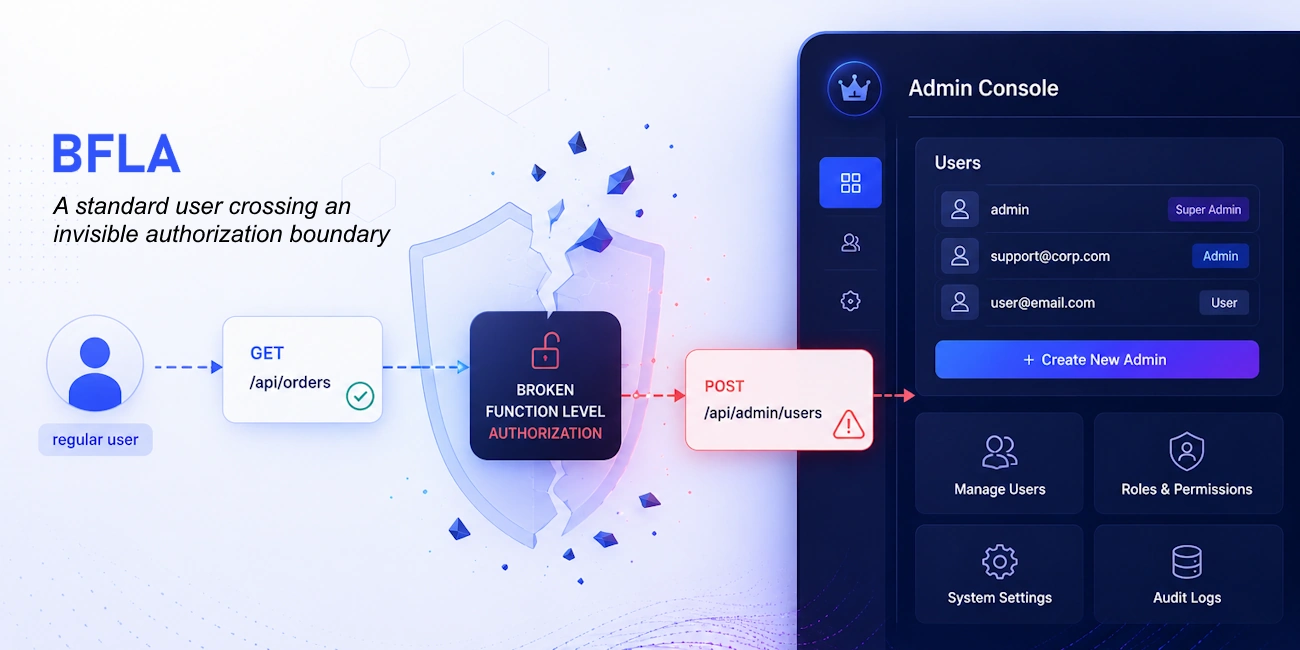
Every api endpoint your application exposes is a potential door. Broken function level authorization is what happens when some of those doors lead straight to admin consoles, and nobody checks who’s walking through. This guide breaks down how BFLA works, why modern applications and AI systems are especially vulnerable, and what developers and security teams can do to lock it down.
What is Broken Function Level Authorization?
Broken function level authorization is a security flaw where an api endpoint allows a user to invoke a function that their role should never permit. BFLA concerns what actions a user may perform in an application, not just what data they can see. The function executes successfully because authorization checks are missing or misconfigured on the server side. BFLA allows unauthorized users to execute restricted API functions like creating admin accounts, changing roles, or deleting records.
Consider a regular user calling POST /api/admin/users to create an administrator, or switching from GET /api/invoices to DELETE /api/invoices/1234 without any additional checks blocking the request. Both succeed because the server never verified whether the caller’s role permits that specific action.
BFLA is recognized by OWASP as a top API security risk. Specifically, BFLA is the fifth most critical threat in the OWASP API Top 10 (2023 edition), listed as API5:2023. It remains a leading cause of privilege escalation in production APIs worldwide.
How BFLA differs from BOLA and other access control flaws
BFLA is one specific type of broken access control focused on which different functions can be called, not which objects can be viewed or modified. Understanding this distinction is a critical part of building secure APIs.
BOLA (Broken Object Level Authorization) is about data access boundaries. With BOLA, a user can read or modify /api/accounts/12345 that belongs to someone else by swapping the resource identifier. The function itself is permitted for their role; the problem is the object they’re targeting. BFLA is fundamentally different: the user can call POST /api/admin/accounts/ or /reset-all-passwords even though they’re not an admin. The operation itself is off-limits, regardless of which object it targets.
Both horizontal and vertical privilege escalation appear in BFLA. Vertical escalation means a basic user invoking administrative functions like user management or configuration changes. Horizontal escalation means a user in one tenant calling global reporting endpoints or operations scoped to a peer tenant. BFLA can lead to unauthorized account access or privilege escalation in either direction.
BFLA is often harder to spot in code reviews because it hides in business logic branches and scattered authorization checks per function. Unlike BOLA, where you can pattern-match on resource ID handling, BFLA requires reviewing every endpoint to confirm that the right roles are enforced for the right HTTP method.
Still wondering where BFLA fits among the other major API risks? Explore how the OWASP API Top 10 (2023) reshaped API security priorities and why BFLA continues to remain one of the most exploited authorization vulnerabilities.
Why modern APIs and AI systems are especially exposed
Modern applications expose dozens or hundreds of api endpoints for web, mobile, and machine-to-machine clients. Each endpoint supports multiple HTTP verbs, and each verb may represent a completely different function. Multiply that by complex role hierarchies, including admins, support staff, partners, service accounts, and sub users, across multi-tenant structures with organizations, projects, and sub-accounts, and you have an access control surface that’s extremely difficult to govern consistently.
AI systems and AI models compound the problem. AI agents often make an api call autonomously, chaining requests across endpoints to perform actions or retrieve training data. If a BFLA vulnerability exists, a compromised or misconfigured agent can silently trigger privileged functions without any human in the loop. This makes AI security posture a growing concern as artificial intelligence integrates deeper into business functions.
Heavy use of REST and GraphQL APIs, automation, and CI/CD pipelines means endpoints appear faster than security reviews can keep up. Shadow endpoints, including deprecated but still deployed features, forgotten beta tools, and internal utilities exposed on the public API gateway, frequently lack updated authorization logic. These create new opportunities for attackers.
As organizations improve authentication, attackers increasingly pivot to BFLA because it abuses legitimate credentials and authentication tokens rather than bypassing login. The user is who they say they are. They just shouldn’t be allowed to do what they’re doing.
How Broken Function Level Authorization attacks work in practice
Attackers exploit BFLA by manipulating api requests to gain access to unauthorized functionality. The process usually starts with reconnaissance. An attacker maps the API surface using browser dev tools, mobile proxying (intercepting api traffic from an Android app, for instance), documentation, OpenAPI/Swagger files, or leaked Postman collections. Every URL path and endpoint URL they discover goes into their inventory.

Next, they experiment with HTTP methods on discovered paths. They switch between GET, POST, PUT, PATCH, and DELETE to see which methods are accepted. Many APIs only protect some HTTP methods on a given path. A GET request might return a proper 403 for a non-admin, but sending DELETE to the same path may succeed because nobody added a role check for that verb.
When missing or inconsistent access control exists, attackers can call hidden admin functions that the UI never shows, trigger destructive actions like deleting users or rotating credentials, and bypass the intended admin console entirely. For example, a non-admin user might discover POST /api/v2/billing/invoices/generate-monthly and use it to mass-generate invoices, disrupting financial operations. Attackers can gain administrative access through BFLA vulnerabilities simply by finding the right endpoint.
These attacks succeed using valid sessions and tokens. The attacker doesn’t need to break authentication. They abuse gaps in access control, and the server processes the request as if it were legitimate because, from an identity perspective, it is.
Detailed scenarios: from harmless requests to full compromise
Very small changes in HTTP method, URL path, or request bodies can turn a benign request into a full privilege escalation. Below are two scenarios that illustrate how quickly things go wrong.
Scenario A: workspace takeover on a SaaS platform
A SaaS collaboration platform allows workspace members to view pending invitations. The mobile app legitimately calls GET /api/v1/workspaces/{id}/invites to display a list. An attacker, holding a regular “member” role, discovers that POST /api/v1/workspaces/{id}/invites also exists, accepting a JSON body including “role”: “owner”. The server accepts the request without verifying whether the caller has permission to create owner-level invites. Missing function-level checks let a regular member create a new workspace owner, accept the invite from a second account, and lock out the real admin. The endpoint returns a 201 success response because the authorization check only verified membership, not role level. This is a textbook case where a client sends a request with unexpected parameters and the server blindly complies.
Scenario B: unauthorized bulk export of sensitive data
A customer analytics dashboard offers an “export all data” feature intended only for administrators. The endpoint is POST /api/admin/v3/tenants/{tenantId}/export. The frontend hides it behind admin UI controls, but no role check exists server-side. Common causes of BFLA include relying on hidden UI elements exactly like this. A read-only user copies the URL from a colleague’s HAR file, replays the request with their own token, and triggers a full export of sensitive information, including customer PII. The data loss is immediate and potentially violates data protection regulations. Because the server never validated the caller’s role, the export runs as if an admin triggered it.
Real-world incidents and historical lessons
BFLA vulnerabilities can lead to major real-world breaches, and several public incidents demonstrate the pattern clearly.
In 2018, New Relic had a BFLA vulnerability allowing unauthorized changes to account configurations. Restricted users could invoke administrative endpoints that modified monitoring settings and alert policies. The vulnerable endpoint accepted authenticated requests without verifying that the caller held an appropriate administrative role. The fix involved adding explicit role verification to each affected endpoint and tightening the access management layer.
Bumble’s API allowed users to upgrade accounts without payment verification, a case where BFLA can allow unauthorized users to modify account types. By calling the right endpoint with the right parameters, a free-tier user could unlock premium features. The API trusted the client to send a valid request without cross-checking the user’s subscription status or role against billing records. A single exposed endpoint can disrupt financial systems when payment flows are bypassed at scale.
In a more recent example, the PraisonAI platform (CVE-2026-47416) exposed a PATCH endpoint for workspace member management. Any member could promote themselves to “owner” because the FastAPI dependency framework defaulted the minimum role check to “member” for all routes. The handler accepted a role value from the request body without verifying the requester’s authority, a textbook case of trusting client-supplied data for decision making.
The recurring pattern across these incidents is clear: privilege-changing or configuration endpoints are deployed with only authentication and no robust role or tenant checks. Coordinated disclosure typically leads to temporary API gateway rules, followed by code fixes and improved security controls.
Where BFLA hides in your architecture
BFLA often lives in edge business functions and rarely used workflows, not the obvious login or profile endpoints. BFLA often occurs due to inconsistent authorization checks on APIs, and these inconsistencies concentrate in specific architectural spots.
Admin or staff-only consoles frequently share the same hostname as public APIs. “Ops” or “support” endpoints used by internal tools, such as /api/support/impersonate or /api/admin/resend-all, sit on the same server and gateway as customer-facing routes. Without strict control over which roles can reach them, they become exposed endpoints waiting for someone to discover them.
Batch operations like /bulk-delete or /mass-update, originally added for migrations or backfills, are often forgotten after deployment. Feature-flag endpoints such as /api/features/toggle can change system behavior globally. These represent administrative endpoints that perform actions far beyond the normal user scope.
Naming alone (/api/admin/…) is unreliable because real applications frequently mix admin and non-admin routes under the same path. BFLA vulnerabilities often arise from misconfigured authorization policies where developers assume path prefixes provide security. Legacy endpoints left active for compatibility often have weaker or no function-level authorization because they predate current standards.
API gateways and service meshes help standardize authentication, but they can obscure which microservice actually enforces access control, leading to gaps where neither the gateway nor the service checks roles. This creates data sprawl across services with no single enforcement point.
Security impact: from a single endpoint to a systemic breach
A single broken function-level check can cascade into a full environment compromise once an attacker chains capabilities. BFLA vulnerabilities can lead to unauthorized access to sensitive functions, and from there, the damage compounds quickly.
Data exposure and tampering are immediate risks. Unauthorized exports can leak sensitive data at scale, bulk user modifications can corrupt records, and audit log deletions can erase evidence of malicious activity. Business logic abuse is equally dangerous: attackers can perform actions like granting themselves free plan upgrades, bypassing payment flows, or altering discount rules. Infrastructure damage follows when attackers reach configuration endpoints, turning on debug modes, changing webhook targets, or rotating keys through insecure administrative functions.
When ai systems call such endpoints as part of automated workflows, they can unintentionally amplify damage. An AI agent running an “optimize” loop might repeatedly invoke a misprotected admin function, causing repeated failures in downstream systems or triggering denial of service attacks against internal services. This is why ai security demands the same rigor applied to human users.
Consider an attacker who chains an export endpoint to extract customer records, a notification configuration endpoint to redirect alerts to their own address, and an account-role-change endpoint to create a persistent admin account. That sequence turns a single bfla vulnerability into a full organizational compromise with data loss, operational disruption, and regulatory exposure under GDPR, CCPA, or industry-specific rules.
How to prevent BFLA: design and implementation best practices
Function-level authorization must be explicit, centralized where possible, and enforced consistently for every protected api endpoint and HTTP method. APIs should centrally enforce authorization checks on each endpoint rather than scattering checks across individual handlers.
Server-side enforcement is non-negotiable. Hiding buttons in the UI is never sufficient. APIs must validate user roles before executing sensitive functions, regardless of whether the frontend exposes the feature. Every request must be verified against the caller’s actual permissions.
Implement a centralized access control layer or policy engine. Whether you use RBAC (Role-Based Access Control) or ABAC (Attribute-Based Access Control), the key is that every business function passes through the same authorization gate. Implementing role-based access control is essential to prevent BFLA at scale. Create an internal “function-to-role matrix” that explicitly maps which roles can call which endpoints and methods.
Handle HTTP methods per endpoint with granular permissions. Restricting HTTP methods can help prevent unauthorized API access. Define which verbs are allowed for each path and verify method-specific permissions. A user hierarchy might permit GET for all authenticated users but restrict DELETE to administrators.
Deny by default is a recommended practice to combat BFLA. New endpoints or unclassified functions should block all access unless explicitly permitted. This prevents the common scenario where a developer ships a new endpoint and forgets to add role restrictions.
Embrace least privilege by avoiding monolithic “super roles.” Split admin powers into granular capabilities like “can-export-reports” or “can-manage-users” rather than a single “isAdmin” flag. This approach lets you assign more than one role to users when needed while keeping each role narrowly scoped.
Log and alert on all denied function-level authorization attempts. Security teams should periodically review these logs to detect probing or misconfiguration. Threat detection improves when you can correlate denied requests with user identity and endpoint patterns.
How to test for BFLA vulnerabilities step by step
Effective BFLA testing combines manual exploration with automation and must be done per role and per HTTP method. Testing APIs with varying privilege levels helps identify BFLA vulnerabilities that static analysis alone would miss. Regular testing can uncover BFLA vulnerabilities across API endpoints before attackers do.
Start by enumerating all api endpoints and their documented methods. Pull from OpenAPI specs, source code route definitions, and runtime api traffic captures. Many organizations discover they have far more endpoints than documented, including third-party APIs integrated into their stack. Generate or obtain authentication tokens for each real role: guest, user, manager, admin, and service account. Label them clearly and keep them organized.
Call every endpoint with each role’s credentials, paying special attention to endpoints whose names suggest administration: admin, manage, config, export, bulk, and similar patterns. Don’t stop at documented endpoints. Probe for undocumented paths by examining source code, reverse-engineering mobile apps, or reviewing data sources like server logs.
Manipulate HTTP methods on endpoints systematically. Send DELETE to endpoints usually used with GET. If a GET request to /api/users returns a list, try DELETE /api/users/{id} with a low-privilege token. When the endpoint returns a 200 or 204 instead of 401 or 403 for unauthorized roles, you’ve likely found a BFLA vulnerability. A 200 or 201 response for regular users on admin endpoints typically signals broken function level authorization.
Attempt privilege escalation through request bodies. Change role names, pass flags like “isAdmin”: true, or inject unexpected parameters. Verify the server enforces its own rules rather than trusting client-supplied values. Tools like Burp Suite, OWASP ZAP, and custom scripts can automate much of this process. Integrate BFLA checks into CI pipelines and regression suites so that every deployment gets tested. Machine learning-based scanners are also emerging to help identify patterns of missing authorization.
Continuous protection: monitoring and automation against BFLA
One-time testing is not enough. Teams add new endpoints and change access patterns weekly or daily in modern DevOps environments, creating unexpected shifts in the authorization surface. API security solutions should continuously baseline access patterns and alert on deviations.
Testing for BFLA is only one piece of API security. A complete assessment should also uncover undocumented APIs, authentication weaknesses, excessive data exposure, and other high-risk attack paths that often accompany authorization flaws. API Audit Checklist: A Comprehensive Guide for Security Leaders
Organizations should continuously monitor for suspicious function usage. Watch for non-admin identities calling rarely used administrative endpoints, unexpected http verbs used by specific roles (like DELETE by basic users), and spikes in calls to high-risk operations such as exports, deletions, or role changes. Connect these signals to api security platforms and logging pipelines that can baseline “normal” behavior per endpoint, method, and role, then alert or block anomalies.
When AI models and agents interact with internal APIs, security teams should include those interactions in monitoring and policy enforcement. An AI agent that starts calling admin endpoints it has never called before could indicate misconfiguration, a prompt injection attack, or harmful actions triggered by corrupted training data. These security challenges require the same monitoring rigor applied to human users. Protect your AI security posture by treating machine identities with the same scrutiny as human ones.
Embrace security-as-code: store access control rules, endpoint classifications, and test scenarios in version control so changes can be reviewed and audited. Integrate BFLA checks into CI/CD using automated test suites, policy-as-code engines, and pre-deployment security gates. This makes access management a living, versioned artifact rather than a one-time configuration.
Continuous improvement is necessary. As your API surface evolves, your security risks evolve with it. The combination of runtime monitoring, automated testing, and policy-as-code creates a defense that scales with your application.
Conclusion
Broken function level authorization is about missing checks on what authenticated users are allowed to do, not just what they can see. BFLA is the fifth most critical threat in the OWASP API Top 10, and it remains a top cause of serious breaches because it targets powerful backend functions that can escalate privileges, exfiltrate data, and disrupt operations.
The most important takeaways: treat every api endpoint and HTTP method as a potential admin console. Implement centralized, consistent function-level access control using a default-deny approach. Continuously monitor and test for unauthorized function use across all roles, including service accounts and AI agents.
Start by inventorying your highest-risk endpoints: deletes, exports, role changes, and configuration operations. Add missing authorization checks to everyone. Integrate BFLA testing into your regular release processes so that no new endpoint ships without explicit role enforcement. Disciplined design plus continuous monitoring can make broken function-level authorization largely preventable. The security best practices outlined here aren’t aspirational; they’re table stakes for any team building modern applications.
