


How Many of Your APIs Are Actually at Risk?
When your board asks: “How many APIs do we really have? Which ones could cause problems?” – You don’t want your answer to be “I don’t know”.
APIs are the invisible backbone of modern digital systems. They power apps, connect services, and enable integrations, but not every API is appropriately managed. Some are shadow APIs – undocumented or unapproved. Others are zombie APIs – old, deprecated, but still running. Together, they create hidden risks that can quietly escalate if left unchecked.
Why This Matters
- By 2026, fewer than half of enterprise APIs will be fully managed.
- Around 30% of APIs in applications are third-party, making it harder to track responsibility.
- Many organizations only discover shadow APIs after a security incident – too late.
Real-world consequences aren’t abstract. In 2022, Optus exposed 10+ million customer records via a shadow API. In 2023, St. Luke’s Health System leaked 450,000 patient records via a zombie API.
The cost? API-related attacks have surged 400%, with average breaches costing over $4M – including fines, remediation, and lost trust. Boards want tangible results, not just CVE lists. They’re looking for measurable outcomes: fewer unknown assets, faster response times, and proof that revenue, compliance, and customer trust are protected.
Practical Wins
Some teams have tackled API sprawl methodically. We know an organization that cut its unknown APIs by 80%, regained visibility into over a million API calls, and reduced risk across the board. That’s the type of practical control that makes a real difference.
Take the first step yourself: download the API Security in Action Guided Workbook to map your APIs, understand your risks, and start taking action today. (Download link provided below)
What’s Inside the API Security in Action Workbook

Once you decide to take control of your APIs, the next step is having a practical tool that guides you through the process. That’s exactly what the API Security in Action Guided Workbook delivers – a step-by-step, interactive PDF designed to make your API risks visible and actionable.
The workbook is structured into seven clear sections, each with customizable fields, prompts, and placeholders for charts or heatmaps. It’s not just a static document. It’s a guide you can fill in as you discover, assess, and secure your APIs.
1. Executive Summary with Business Impact
The first page is all about the big picture. Here, you’re prompted to answer questions like:
- “What’s the biggest API risk for your organization right now?”
- “How would a breach here affect revenue, compliance, or reputation?”
A simple visual cue reminds you where to insert your executive summary narrative, keeping it concise and meaningful. The goal is clear: give boards a snapshot of risk and ROI in a single glance, so they instantly understand the stakes and your planned actions.
2. API Discovery & Inventory

Before you can secure APIs, you need to know what exists. This section guides you through cataloging all the APIs your organization relies on.
You’ll find a table template where you can fill in:
| API Name | Environment | Type | Sensitive Data | Owner | Status | Notes |
| [Insert] | [Insert] | [Insert] | [Insert] | [Insert] | [Insert] | [Insert] |
| [Insert] | [Insert] | [Insert] | [Insert] | [Insert] | [Insert] | [Insert] |
Additionally, there’s a visual placeholder for an API inventory chart showing totals, shadow APIs, and unknown endpoints.
The principle here is simple but powerful: you can’t protect what you don’t know. By tracking every API, documented or otherwise, you’re building the foundation for risk prioritization, mitigation, and measurable outcomes.
How do I catalog all APIs? Check out API Audit Checklist: The Definitive Guide to Securing APIs & Preventing Breaches in 2026.
3. Risk Prioritization & Threat Context
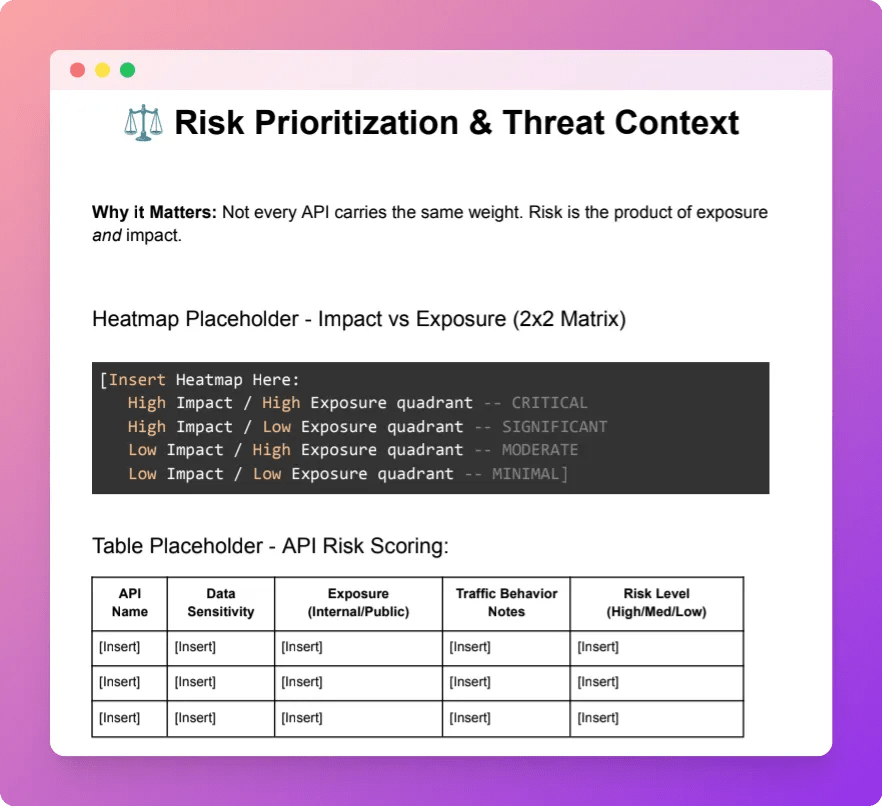
Once you’ve mapped your APIs, the next step is understanding which ones truly matter. Not every API carries the same risk. Some touch-sensitive data, some are public-facing, and some handle high volumes of traffic. The workbook guides you through this with a 2×2 Impact vs Exposure heatmap, a simple visual that quickly shows which APIs are critical, significant, moderate, or minimal in risk.
Alongside the heatmap, you’ll find a table placeholder to capture details for each API:
| API Name | Data Sensitivity | Exposure | Traffic Notes | Risk Level |
| [Insert] | [Insert] | [Insert] | [Insert] | [Insert] |
| [Insert] | [Insert] | [Insert] | [Insert] | [Insert] |
This isn’t just busywork. By prioritizing high-impact and high-exposure APIs, you can focus your security efforts where they matter most, saving time and reducing potential exposure.
Tip: Use this matrix to identify critical APIs and allocate resources effectively quickly.
4. Mitigation Actions & Before/After Impact
Knowing the risk is only half the story. The workbook also walks you through documenting the actions you take to reduce risk. Each API can have a dedicated row showing the control applied: rate limiting, schema validation, authentication hardening, and how metrics improved afterward.
| API Name | Control Applied | Before Metric | After Metric | % Improvement |
| [Insert] | [Insert] | [Insert] | [Insert] | [Insert] |
| [Insert] | [Insert] | [Insert] | [Insert] | [Insert] |
There’s also a placeholder for a before/after graph, showing trends like anomalies detected per week. Seeing the improvement visually reinforces the real-world impact of your mitigation efforts. This section transforms raw security work into measurable outcomes, which executives and boards actually care about.
5. Case Study / Internal Wins
Finally, the workbook encourages you to tell real stories from your organization. One page is reserved for a mini-case study with prompts: Problem → Action → Outcome.
For example:
- Problem: Shadow API exposed sensitive data
- Action: Automated discovery flagged the endpoint and applied authentication
- Outcome: Potential data leakage prevented, MTTR reduced, and compliance gap closed
Documenting wins like this doesn’t just keep your team motivated; it also helps you build a culture of accountability. It makes the data relatable and compelling for stakeholders, showing that the effort invested in API security delivers tangible results.
6. Next Steps & Roadmap
After documenting your API inventory, assessing risk, and tracking mitigation, the workbook’s final pages help you plan what comes next. You’ll find a table placeholder to outline initiatives, assign owners, set timelines, and capture expected outcomes:
| Initiative | Owner | Timeline | Expected Outcome |
| [Insert] | [Insert] | [Insert] | [Insert] |
| [Insert] | [Insert] | [Insert] | [Insert] |
There’s also space to capture your top three priorities, helping your team focus on the actions that will have the most significant impact first.
This roadmap isn’t just about ticking boxes. It’s about keeping your API security program actionable and forward-looking. When everyone knows what to do next, progress becomes measurable, and your stakeholders can see the momentum.
7. Notes & Appendix
Finally, the workbook includes a dedicated section for additional context, including screenshots, logs, and compliance mapping for standards such as PCI DSS, GDPR, and HIPAA.
This extra detail is invaluable for audits, board reviews, or deep-dive sessions where evidence matters. Even if you’ve done all the hard work in prior sections, having a single place for reference ensures nothing gets lost and all outcomes are documented clearly.
Download the PDF and start your 7-day API security challenge today.
With the workbook complete, you now have a step-by-step, interactive guide to map your APIs, prioritize risk, demonstrate mitigation, and communicate value to the board. It turns what was once invisible – shadow and zombie APIs into measurable, actionable insight, making API security a clear and strategic advantage.
Also check out:
- API Hacking Cheat Sheet: How Hackers Break APIs (and How to Stop Them)
- NIST API Security Best Practices: The Complete 2026 Guide
Understanding Risk Mapping: Prioritizing What Matters Most

Once you’ve inventoried your APIs, the next step is to determine which poses the most significant risk. Not every endpoint deserves the same attention, and that’s where an Impact vs Exposure matrix comes in.
The logic is simple:
- Impact measures the severity of the consequences if an API were compromised. Think data breaches, regulatory fines, operational downtime, lost revenue, or reputational damage.
- Exposure assesses the likelihood that a threat will occur. Consider how frequently an API is called, whether it’s public-facing, or if monitoring is lacking.
Combine these two dimensions, and you get a risk score. A common approach multiplies likelihood by impact to produce a number that fits neatly into color-coded severity zones: green for low, yellow for medium, and red for critical.
For example, a customer payment API that handles frequent financial transactions but lacks strong authentication might score 5 (impact) × 5 (exposure) = 25, marking it as critical. Meanwhile, an internal HR API with limited exposure might sit comfortably in the low-risk zone.
| API Name | Impact | Exposure | Risk Score | Risk Level |
| Payment API | 5 | 5 | 25 | Critical |
| Internal HR API | 3 | 2 | 6 | Low |
| Customer Data API | 4 | 4 | 16 | High |
| Marketing API | 2 | 4 | 8 | Medium |
To make your risk mapping actionable, it’s essential to integrate OWASP API Top 10 categories such as Broken Object-Level Authorization, Excessive Data Exposure, and Security Misconfiguration. This ensures your scoring reflects real-world threats, not just abstract numbers.
Remember, these matrices aren’t one-time exercises – they’re living tools. Review quarterly, adjust for new APIs or threat trends, and always tie prioritization to business impact. Replicating this approach in your PDF workbook gives you a clear visual and numerical guide to focus efforts where they matter most.
Replicate this impact vs exposure matrix in your API Security workbook to prioritize and address the highest-risk APIs first.
Documenting Mitigation: From Controls to Measurable Improvement

Identifying high-risk APIs is only half the battle. The next step is documenting and tracking how you mitigate those risks. A structured playbook turns vague security initiatives into measurable results that boards and auditors can understand.
Start with the key controls every API should have:
- Rate Limiting: Restrict the frequency of API calls to prevent brute force attacks, scraping, and DDoS. For instance, Instagram implements rate limits to protect its services from abuse and ensure that third-party applications do not negatively impact the user experience.
- Schema Validation: Ensure endpoints accept only the intended data structures, preventing injection attacks and mass-assignment exploits. State Farm uses JSON Schema Validation in AWS API Gateway to protect its APIs, following the OpenAPI 3 specification.
- OAuth Hardening: Tighten authentication scopes, rotate secrets, enforce token expiry, and prevent privilege escalation. PayPal experienced a data breach affecting 35,000 accounts due to credential-stuffing attacks, underscoring the importance of robust OAuth practices.
Tracking before-and-after metrics is crucial. It makes the benefits tangible and allows you to report real progress:
| API Name | Control Applied | Before Metric | After Metric | % Improvement |
| Payment API | Rate Limiting | 2,400 anomalies/month | 192 anomalies/month | 92% |
| Data API | Schema Validation | 41 misassignments/week | 3 misassignments/week | 93% |
| Login API | OAuth Hardening | 180 attacks/month | 11 attacks/month | 94% |
Your mitigation playbook should log these details for each high-risk API: the controls applied, pre- and post-metrics, and alignment with business KPIs such as MTTR, fraud losses, or incident costs. By keeping it in a living workbook format, your team can update defenses regularly, demonstrate measurable progress to executives, and ensure audit readiness.
Document each mitigation in your workbook. Track pre- and post-metrics and update quarterly.
Real-World API Security Wins: Case Studies
Seeing risk is one thing, reducing it is another. Let’s look at three real-world scenarios where organizations turned API insights into measurable security wins.
E-commerce / Telecom: Shadow & Dormant APIs Exposed
In 2022, the Optus breach in Australia revealed how dangerous forgotten or misconfigured APIs can be. A dormant API without proper authentication exposed the personal data of millions of customers, including driver’s license numbers and home addresses. The issue wasn’t just a technical bug; it was a governance failure: undocumented, unmonitored APIs slipped through the cracks.
While Optus became a cautionary tale, the lesson applies to any business with sprawling APIs. Continuous discovery, automated governance, and runtime monitoring are the only ways to ensure “zombie” or shadow APIs don’t silently expand your attack surface.
Lesson: Shadow APIs are not hypothetical. They’re behind some of the world’s most significant breaches. If you can’t inventory them, you can’t secure them.
Healthcare: Compliance Gaps & Board Confidence
A U.S. healthcare provider conducted an API audit and discovered more than 150 undocumented endpoints, many of which lacked encryption or monitoring. These gaps left the organization at risk of HIPAA and GDPR violations, with fines that could have run into the millions of dollars.
By implementing automated compliance checks and centralizing API documentation, the provider achieved 95% coverage across all endpoints. The result: audit preparation times dropped by 40%, and executives regained confidence that API risk was under control.
Lesson: In regulated industries, API traceability is a compliance necessity, not just a technical exercise. Boards don’t want to hear about “rogue endpoints”. They want evidence that every API is documented and governed.
(Composite case based on common patterns reported in healthcare API security audits – e.g., PCI/HIPAA requirements)
FinTech: Credential Stuffing Attacks Prevented
In 2023, genetic testing company 23andMe was fined £2.3M after a massive credential stuffing attack exploited their login API. Attackers reused leaked usernames and passwords from other breaches, exposing the data of nearly 7 million users.
A leading FinTech firm facing similar risks took proactive measures: tightening OAuth scopes, rotating secrets, enforcing token expiry, and adding MFA. Within 9 months, credential stuffing attempts dropped by 93%, and incident response time (MTTR) was cut from 24 hours to 9 hours.
Lesson: Credential stuffing is no longer theoretical. It’s hammering APIs every day. Strong authentication design and OAuth hardening aren’t “nice to have”; they’re the difference between breach headlines and business continuity.
Proving ROI & Business Value
Boards and executives don’t want technical jargon. They want measurable outcomes. API security investments can now be tied directly to business value.
Sample Metrics to Track from the Workbook:
- Shadow API Reduction: 200 → 25 (87%)
- MTTR Improvement: 24 hours → 9 hours
- Incident Rate Decrease: 75% fewer API breach attempts in six months
- API Coverage & Compliance: 95% endpoints documented; audit readiness +40%
- Breach Cost Avoidance: Average potential cost $4.88M
(The above figures were sample statistics and examples)
Visual representations – bar charts of incident frequency, pie charts for coverage, trend lines for MTTR – make these improvements tangible and easy to communicate to boards.
Business Insights:
Every dollar invested in API monitoring and control yields measurable returns: faster incident detection, fewer compliance fines, reduced operational risk, and stronger customer trust.
Insert these metrics into your PDF to immediately show ROI.
Common Mistakes to Avoid
Even with the best tools, teams make predictable errors that dilute impact:
- Too Technical: Focusing on complex control configurations without connecting them to business risk. Boards don’t need “unpatched endpoints”; they need to understand exposure in dollars or in terms of compliance impact.
- Too Vague: Claims like “security improved” are meaningless without metrics. Always quantify improvements (e.g., API incidents down 87%).
- No Clear Solutions: Highlighting problems like shadow APIs without explaining how to detect and remediate them leaves teams paralyzed.
- Stale Data: Using outdated metrics or ignoring recent incidents erodes credibility. Reference current threats and trends.
- Lack of Tailoring: Generic reports frustrate both executives and engineers. Present summaries linked to business KPIs for leadership, and technical details for operations teams.
Addressing these pitfalls ensures your API security program not only exists but proves its value and earns executive trust.
Also read:
How to Use the PDF in Practice

Your API security workbook isn’t just a one-off checklist. It’s designed to become part of your organization’s rhythm. Think of it as a playbook that adapts with you.
- Quarterly Board Meetings: Use the risk scoring tables and case study templates to brief the board on progress. Instead of vague updates, show how shadow APIs dropped 80% or how MTTR improved by hours. Boards respond best to concise visuals and trends, not raw technical logs.
- Monthly Executive Updates: Use the metrics dashboard to speak the language of business value. For example: “API abuse incidents are down 70% since OAuth hardening” or “audit readiness improved 40%.” Executives want outcomes – cost saved, downtime avoided, compliance achieved.
- Annual Reviews: Step back and use the workbook for year-over-year comparisons. Highlight long-term wins: reduction in breach attempts, increased coverage, or reduced audit time. These reviews demonstrate ROI and justify continued investment.
Download the PDF and start your 7-day API security challenge. Create your first risk map, document one mitigation, and deliver a measurable win at your next meeting.
Why AppSentinels?
All the best practices in this guide – discovery, risk mapping, mitigation, and ROI need a platform that can actually execute them. That’s where AppSentinels comes in.
- Unified Lifecycle Security: Discovery, continuous pen-testing, runtime protection, and remediation – all built into a single platform from development to production. No patchwork of tools.
- Business Logic & AI Protection: With its Business Logic Graph, AppSentinels understands workflows, user journeys, and data flows – catching abuse that traditional scanners miss. Plus, it’s agentic AI-ready, defending against rogue AI agents and AI-driven exploits.
- Enterprise-Proven Scale: Securing 100B+ API calls monthly across banks, fintech, and retail, AppSentinels handles scale without latency issues. Cloud, on-prem, or hybrid with HA/DR support. It just fits.
- AI-Driven Insights: Automated pen-testing, real-time risk scoring, and compliance analytics (HIPAA, PCI, GDPR). It’s like having a 24×7 security analyst at your side.
- Seamless Integration: Works with 50+ CI/CD and ticketing tools, gateway-agnostic, with inline or out-of-band deployment. Designed for both SecOps and DevOps.

In short, AppSentinels transforms API security from reactive firefighting into continuous risk management. It’s the difference between scrambling after an incident and confidently showing the board a live, measurable reduction in risk.
If you’re serious about making the PDF more than a workbook, AppSentinels is the platform that turns it into practice.
FAQs: Top 10 API Security Questions
1. How do I discover shadow APIs quickly?
Start with automated discovery tools integrated into gateways and traffic mirrors. Manual spreadsheets don’t scale.
2. Which KPIs matter most to my board?
Focus on coverage (discovered vs. undocumented APIs), time-to-detect, time-to-remediate, and risk reduction expressed in business terms.
3. How often should API security be reviewed?
Quarterly for governance reporting, continuously in production. API risk is dynamic; new endpoints emerge every sprint.
4. What’s the #1 mistake teams make?
Treating API security as a one-off penetration test instead of a continuous lifecycle practice.
5. Do API gateways provide enough security?
No. They control access but don’t catch business logic abuse, rogue workflows, or zero-day exploits.
6. How do I justify API security ROI to executives?
Frame in avoided downtime, regulatory fines, reduced incident costs, and accelerated compliance audit readiness.
7. Where do compliance requirements come in?
Regulations such as GDPR, HIPAA, and PCI explicitly require data access controls, audit logs, and breach prevention measures. APIs are often the weak link.
8. How do I secure APIs against AI-driven threats?
Adopt platforms that detect abnormal agent behaviors and sequence misuse, not just credential theft.
9. Who should own API security: developers or security?
It’s shared: developers own secure design and testing, security teams enforce runtime and governance.
10. What’s the first step if I don’t know where to start?
Run a discovery scan today. You can’t protect what you don’t know exists.
Securing APIs, Securing the Future
APIs are no longer background technology. They run your payments, customer logins, AI models, and your core business. But with that power comes risk, and ignoring it isn’t an option anymore.
This guide shows that API security doesn’t have to feel overwhelming. When you break it down into clear steps – Inventory → Risk → Mitigation → ROI → Roadmap. It becomes something leaders can measure, track, and actually act on.
That’s the real win: security moves from being a technical fire drill to a business enabler. Boards see risk in financial terms. Executives see progress in weeks, not years. Teams stop playing catch-up and start leading.
And that’s exactly what the API Security in Action Guided Workbook is built for. It gives you a practical framework to:
- Uncover hidden APIs before attackers do
- Prioritize the threats that truly matter.
- Prove improvements with before/after metrics.
- Walk into your next board meeting with clarity, not jargon
The companies that thrive in the next decade will be the ones that treat API security as core infrastructure, not an afterthought. This is your chance to start building that foundation today.
📥 Download the “API Security in Action” Guided Workbook now and take the 7-day challenge. In just one week, you’ll turn security from a vague worry into a story of resilience, trust, and growth.
Because APIs are your business. It’s time to secure them like it.