
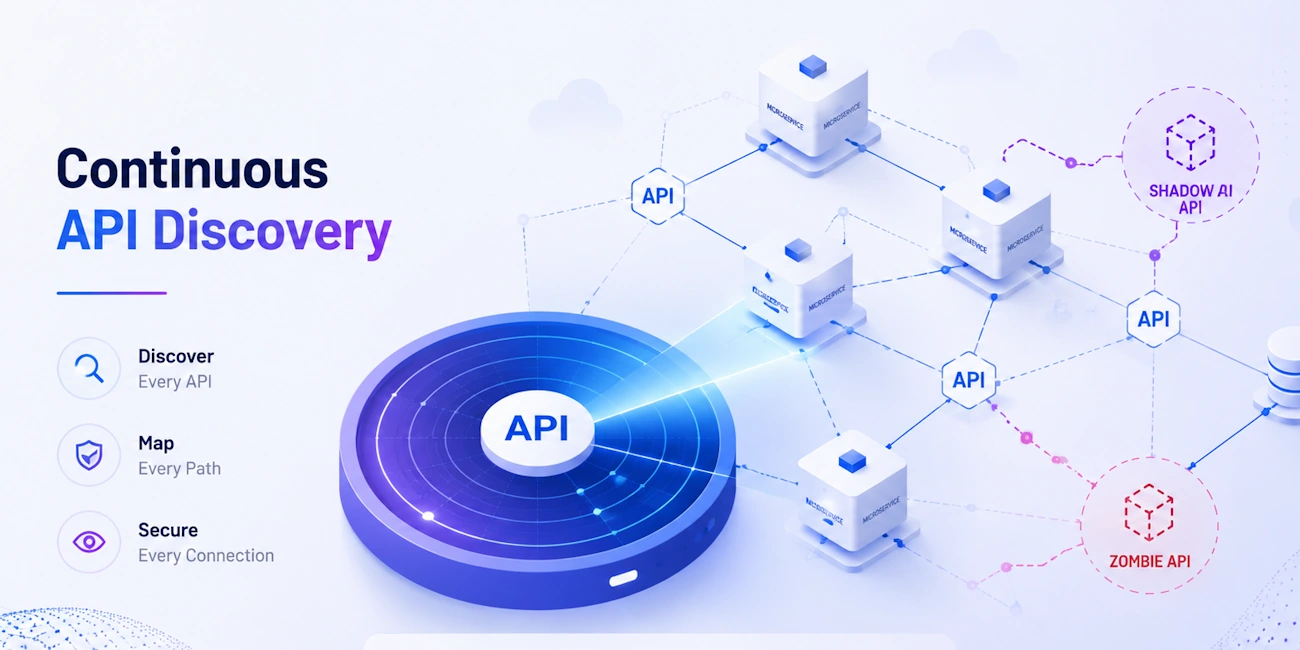

Your enterprise runs on APIs. Every customer interaction, every data exchange, every AI decision flows through endpoints that multiply faster than your documentation can track. A single undocumented API sitting in production becomes an open door for attackers-and according to recent security research, organizations discover 40-60% more APIs than their gateway configurations show.
This gap between what you think exists and what actually runs in production creates real business risk. AppSentinels helps enterprise SaaS teams close this visibility gap through automated API discovery that maps every endpoint across your microservices architecture. This guide walks you through building an accurate API inventory, establishing lineage mapping, and achieving runtime visibility that keeps pace with modern development cycles.
You’ll learn practical approaches for identifying shadow APIs before attackers do, tracking data flows across distributed systems, and maintaining security posture as your API ecosystem scales.
Key Takeaways: Continuous API Discovery in Microservices for 2026
- Shadow APIs and zombie APIs create hidden attack surfaces that traffic-based monitoring alone cannot detect-you need code-based discovery too.
- API lineage mapping reveals data flow dependencies across microservices, helping you prioritize security controls where sensitive information travels.
- Runtime visibility gives you real-time insight into API behavior patterns, enabling faster threat detection and incident response.
- AppSentinels delivers full lifecycle API security with automated discovery, posture management, and runtime protection in a unified platform.
- Effective API inventory management reduces compliance audit preparation time and prevents regulatory penalties tied to undocumented data flows.
What Is Continuous API Discovery and Why Does It Matter?
API discovery is the process of identifying every endpoint in your organization-documented or forgotten, active or deprecated. In microservices environments where teams deploy independently and AI coding assistants accelerate development, new APIs appear daily without centralized tracking.

The “continuous” distinction matters here. Point-in-time audits create snapshots that become outdated within weeks. Your security team cannot patch vulnerabilities in APIs they don’t know exist. And attackers actively hunt for these unmanaged endpoints.
A complete discovery approach captures endpoint URLs, supported methods (GET, POST, PUT, DELETE), parameters, authentication mechanisms, and data sensitivity classifications. This foundation enables everything else-from compliance documentation to runtime threat detection.
How Do Shadow and Zombie APIs Create Hidden Attack Surfaces?
Shadow APIs are endpoints deployed outside your security governance. Developers create them during testing, for small internal use cases, or as temporary solutions. They often lack proper authentication, encryption, and monitoring. Company mergers notoriously produce shadow APIs as systems integrate without comprehensive inventory reconciliation.
Zombie APIs present a different risk. These deprecated endpoints were secured and maintained at some point but have since been abandoned. They may still connect to production databases and handle sensitive data, yet no one applies security patches or monitors their traffic.
Both types expand your attack surface in ways you cannot address until you find them. Attackers discover these APIs through automated scanning, code leaks, and trial-and-error probing. The breach that makes headlines often traces back to a forgotten endpoint that evaded security controls for months.
Why Traditional Monitoring Misses Hidden APIs
Traffic-based discovery only catches APIs receiving production traffic through monitored gateways. Internal microservices that bypass your gateway, pre-production endpoints, and rarely-called APIs remain invisible. Code repository scanning fills this gap by identifying endpoint definitions before deployment.

The most complete coverage combines both approaches: code-based discovery finds APIs early in development, while runtime monitoring validates what’s actually running in production.
How to Build an Accurate API Inventory for Enterprise Microservices
An API inventory goes beyond listing endpoints. You need metadata about ownership, traffic flow details, authentication policies, versioning status, and data sensitivity classifications. Without this granularity, your security team cannot enforce least-privilege access or assess risk exposure.
Essential Components of Your API Inventory
Start with endpoint identification-the URLs your applications use to interact with each API. Document supported HTTP methods and the parameters each endpoint accepts. Map authentication mechanisms: OAuth, JWT, mutual TLS, or API keys.
Track ownership. Every discovered API needs a responsible team assigned for maintenance and security updates. APIs without clear ownership become “someone else’s problem” and drift into vulnerability.
Classify data sensitivity. Which APIs handle PII, payment card information, or protected health information? This classification drives your prioritization when allocating security resources.
Automation Is Non-Negotiable at Scale
Manual tracking through spreadsheets fails when you’re managing hundreds or thousands of endpoints. APIs evolve rapidly, developers overlook documentation updates, and human error compounds over time.
AppSentinels automates API inventory management by scanning environments for undocumented endpoints, classifying APIs by risk level, and maintaining real-time accuracy as your architecture changes. This approach eliminates the lag between deployment and visibility that creates security gaps.
What Is API Lineage Mapping and How Does It Strengthen Security?
Lineage mapping tracks how data flows through your API ecosystem-which endpoints call which services, what information passes between microservices, and where sensitive data travels across your architecture. This visibility matters for both security and compliance.
When you understand API dependencies, you can assess the blast radius of a potential breach. If an attacker compromises one endpoint, lineage mapping shows you every downstream service that might be affected. You can contain incidents faster and prioritize remediation based on actual risk.
Connecting APIs to Business Functions
Effective lineage mapping links technical endpoints to business processes. An API that processes payment transactions carries different risk weight than one that serves static marketing content. This business context helps security teams make informed decisions about access controls and monitoring intensity.
Regulations like GDPR and HIPAA require documentation of data processing activities. API lineage mapping generates the evidence auditors need, showing exactly how personal or health information flows through your systems.
How Does Runtime Visibility Enable Real-Time Threat Detection?

Runtime visibility means monitoring API behavior as it happens-not reviewing logs after an incident. You capture request patterns, response anomalies, and traffic characteristics that indicate potential attacks or data exfiltration attempts.
Behavioral analysis establishes baselines for normal API usage. When an endpoint suddenly receives unusual request volumes, transfers unexpected data quantities, or gets called from unfamiliar sources, runtime monitoring flags the anomaly for investigation.
From Detection to Response
Static inventories tell you what exists. Runtime visibility tells you what’s happening. This distinction determines whether you catch an attack in progress or discover the breach months later during a compliance audit.
AppSentinels delivers runtime protection through real-time monitoring and deep visibility across your entire application lifecycle. The platform identifies threats based on actual API behavior rather than predefined rules alone, adapting to the unique patterns of your microservices architecture.
What Discovery Approaches Work for Modern Microservices Architectures?
Different discovery methods find different types of APIs. Understanding the strengths and limitations of each approach helps you build a strategy that covers your entire environment.
Traffic-Based Discovery
This approach monitors network traffic and API gateway logs to identify endpoints based on actual usage. It excels at understanding current API activity, finding frequently-called endpoints, and establishing usage patterns. However, traffic-based discovery misses pre-production APIs, rarely-called endpoints, and internal services that bypass your gateway.
Code Repository Discovery
Scanning source code repositories identifies API endpoint definitions regardless of deployment status. This shift-left approach catches shadow APIs during development when they’re easiest to document or remove. The limitation: it won’t find third-party APIs without local definitions or endpoints that haven’t been committed to version control.
The Hybrid Approach for Complete Coverage
Organizations with mature API security practices use both methods together. Code-based discovery finds APIs early in the development lifecycle. Runtime traffic monitoring validates what’s actually running in production. The combination closes visibility gaps that either approach alone would leave open.
How Do You Prioritize API Security After Discovery?
Finding a thousand endpoints helps no one if they’re not prioritized by risk. Discovery without action creates a catalog that sits unused while attackers exploit your most vulnerable APIs.
Risk-Based Classification
Focus first on APIs handling sensitive data-PII, payment information, health records. Prioritize public-facing endpoints over internal services. Authentication mechanisms deserve early attention because broken authentication opens doors to everything else.
Assign ownership immediately. Every discovered endpoint needs a team responsible for its security. This accountability prevents APIs from becoming orphaned assets that drift into vulnerability.
Connecting Discovery to Testing
Finding endpoints is the first step. Testing them for OWASP API Security Top 10 vulnerabilities turns discovery into actionable security improvement. The most effective platforms combine both capabilities in a single workflow.
What Compliance Requirements Drive API Discovery Adoption?
Regulations increasingly recognize APIs as critical security vectors. An incomplete API inventory renders audit readiness nearly impossible and exposes you to financial penalties.
Key Regulatory Frameworks
PCI DSS v4.0.1 requires organizations to maintain an inventory of all custom software, including API components. GDPR Article 30 mandates documentation of all data processing activities-APIs that handle personal data fall squarely within this scope.
The EU Cyber Resilience Act requires complete software bills of materials including API dependencies. ISO 27001 demands asset inventory covering all information processing systems. Healthcare organizations face HIPAA requirements for documenting systems that transmit protected health information.
From Compliance Burden to Competitive Advantage
Organizations that automate API discovery transform compliance from a painful audit exercise into an ongoing capability. Real-time inventory accuracy reduces preparation time when auditors arrive. Automated reporting generates the documentation regulators require without manual data gathering.
How Does AI Change the API Discovery Landscape?
AI-driven development accelerates API proliferation. Coding assistants help developers create endpoints faster than ever. AI agents and MCP (Model Context Protocol) servers introduce new categories of APIs that interact with large language models and autonomous systems.

This acceleration demands equally sophisticated discovery capabilities. Machine learning models can detect undocumented APIs, classify endpoints by risk level, and correlate API inventory data with known attack patterns. Predictive threat detection analyzes historical API behavior to identify vulnerabilities before exploitation.
Discovery for AI-Driven Applications
Modern applications increasingly feature AI decision-making where APIs execute the actions those decisions trigger. AppSentinels addresses this evolution by delivering API security across environments where AI makes decisions and APIs execute actions, protecting 150K+ unique API endpoints and 5K+ AI agents.
As agentic applications become standard, discovery must extend to these new interaction patterns-not just traditional REST endpoints but the full range of AI-driven API communications.
What Common Mistakes Undermine API Discovery Efforts?
Even organizations that invest in discovery often fail to achieve meaningful security improvements. Avoiding these pitfalls separates effective programs from checkbox exercises.
Treating Discovery as a One-Time Project
APIs change constantly. New endpoints ship daily in fast-moving organizations. A discovery initiative that produces a point-in-time snapshot becomes outdated within weeks. You need automation that keeps your inventory current as your architecture evolves.
Discovering Without Assigning Ownership
Accountability matters. Every discovered API needs a responsible team for maintenance and security. Without ownership, you’ve created a catalog of vulnerabilities with no one assigned to fix them.
Focusing Only on REST Endpoints
GraphQL and gRPC usage has expanded significantly across enterprise architectures. Discovery that ignores these protocols leaves blind spots in your security coverage. Your attack surface isn’t limited to one protocol, and your discovery shouldn’t be either.
Separating Discovery from Security Testing
Finding APIs is necessary but not sufficient. You need to test discovered endpoints for vulnerabilities and integrate findings into your remediation workflow. The gap between discovery and action is where risk accumulates.
How Do You Implement a Lifecycle Approach to API Security?
Full lifecycle API security connects discovery, posture management, and runtime protection into a unified strategy. Each component reinforces the others.
Discovery Feeds Posture Management
Your API inventory becomes the foundation for security posture assessment. You can evaluate authentication mechanisms, encryption standards, and access controls across all endpoints. Gaps in posture management highlight where to focus remediation efforts.
Posture Informs Runtime Protection
Understanding your security posture enables more effective runtime monitoring. You know which APIs handle sensitive data and which endpoints have weaker controls. This context sharpens threat detection and prioritizes alerts based on actual risk.
Runtime Insights Update Discovery
Runtime monitoring reveals APIs that weren’t captured during initial discovery-endpoints that only receive traffic under specific conditions or services that were deployed outside normal processes. This feedback loop keeps your inventory accurate.
AppSentinels unifies these capabilities in a full lifecycle API security platform that addresses discovery, posture, and runtime protection together. This integrated approach eliminates the coordination overhead of managing separate point solutions.
How Do Zero Trust Principles Apply to API Security?
Zero Trust architecture eliminates implicit trust for all system interactions, including API calls. Every request must be authenticated, authorized, and validated regardless of network location.
Applying Least Privilege to APIs
Restrict API interactions to only what’s necessary. Applications should access only the endpoints they require, with permissions scoped to specific operations. This minimizes the blast radius when credentials are compromised.
Moving Beyond Static API Keys
Traditional API keys grant persistent access without context awareness. Zero Trust implementations use dynamic access controls where permissions adjust based on user behavior, request characteristics, and risk signals. Short-lived tokens replace long-lived credentials.
Context-Aware Security Decisions
Access decisions incorporate multiple factors: the identity making the request, the sensitivity of the requested resource, the time and location of the request, and recent behavior patterns. This adaptive approach responds to changing risk conditions in real time.
How Can You Future-Proof Your API Discovery Strategy?
API ecosystems will keep growing in complexity. Microservices architectures, AI-driven applications, and third-party integrations expand the number of endpoints you need to track. A forward-looking strategy anticipates this growth.
Invest in Automation Over Manual Processes
Manual API tracking cannot scale with modern development velocity. Automated discovery that integrates with your CI/CD pipeline catches new endpoints as code is deployed. This integration ensures discovery happens as part of your existing workflow rather than as a separate security activity.
Plan for Multi-Protocol Environments
Your discovery capabilities should cover REST, GraphQL, gRPC, and WebSocket protocols. As new communication patterns emerge, your tools need flexibility to adapt. Avoid locking into solutions that only address today’s technology stack.
Connect Discovery to Business Outcomes
Frame API security in terms that resonate with business stakeholders. Reduced breach risk, faster compliance audits, and improved developer productivity justify continued investment. Discovery isn’t just a security initiative-it’s an operational capability that supports business agility.
In Conclusion: Building Visibility Into Your API Security Foundation
You cannot secure what you cannot see. For enterprise SaaS teams operating microservices architectures, visibility starts with understanding every API in your environment-where it lives, what data it handles, and how it behaves at runtime.
Building accurate API inventory takes more than periodic audits. You need automated discovery that keeps pace with development velocity, lineage mapping that reveals data flow dependencies, and runtime visibility that detects threats as they happen. AppSentinels enables this visibility through a unified platform that addresses the full API security lifecycle. Whether you’re securing existing microservices or preparing for AI-driven application architectures, accurate API discovery forms the foundation for everything else.


