
TL;DR
- MCP agents inherit their orchestrating application’s full permission scope by default, creating catastrophic over-provisioning that attackers exploit through prompt injection, tool poisoning, and privilege escalation across agent chains.
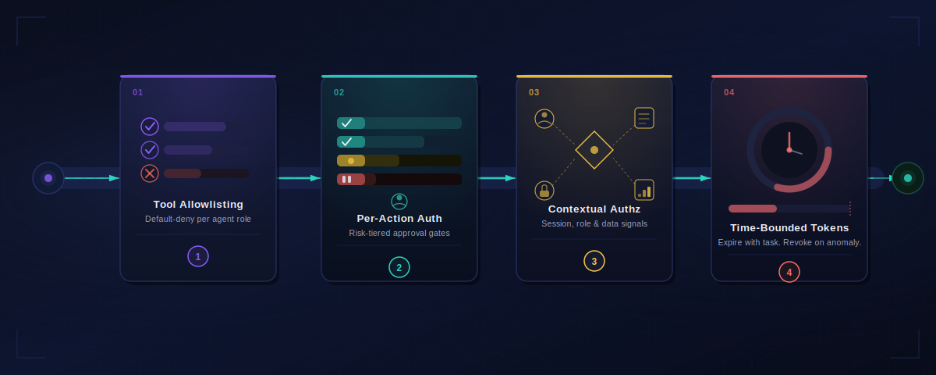
- Four enforcement patterns: tool allowlisting, per-action authorization, contextual authorization, and time-bounded tokens form a layered access control stack that covers both static and dynamic MCP threat surfaces.
- OAuth 2.0 with dynamic client registration is the recommended MCP authorization framework, but it requires enterprise extensions for agentic environments.
- Multi-agent pipelines demand dedicated privilege isolation: sub-agents must operate under their own minimally scoped credentials, never inheriting parent agent permissions .
The Permission Inheritance Problem Nobody Is Talking About
When an enterprise deploys an MCP-powered AI agent, such as a coding assistant, a customer workflow automaton, an IT helpdesk bot, something quietly dangerous happens at startup. The agent inherits the full permission set of the application that launched it. If the orchestrating app holds write access to a production database, the MCP agent does too. If it can call financial APIs, trigger deployments, or read HR records, the agent inherits all of that, without ever explicitly being granted those rights.
This is not a bug. It is the current default behavior of the Model Context Protocol’s authorization model. And it is the single most exploitable condition in modern agentic AI architectures.
Why attackers target this gap immediately: A prompt injection payload embedded in a document an MCP agent reads doesn’t need to bypass authentication. The agent already has the credentials. The attacker’s only job is to redirect what the agent does with them.
The consequences cascade fast. An agent with database write access gets fed a malicious prompt (perhaps buried in a retrieved Confluence page, a support ticket, or a tool description) and begins exfiltrating records, modifying entries, or silently escalating its own privileges across the agent chain. The blast radius of a single compromised MCP session can now span the entire enterprise tool surface the parent application was authorized to reach.
The answer is not to slow down MCP adoption. Agentic AI is delivering real productivity. The answer is enforced least privilege: ensuring every MCP agent, at every moment, holds exactly the permissions it needs for the task it is performing — and nothing more. This guide explains how to get there.
The MCP Permission Model Explained
Understanding where the authorization gaps live requires understanding how MCP structures access in the first place. MCP’s architecture connects three components: MCP Clients (the AI application: Claude Desktop, a custom LLM wrapper, an IDE extension), MCP Servers (the systems exposing tools, resources, and prompts), and the Tools themselves.
Authorization in this model operates across two planes that are often conflated but fundamentally separate:
- Client-to-server authentication: How an MCP Client proves its identity to an MCP Server. This is relatively mature — OAuth 2.0 tokens, API keys, mutual TLS — though not yet consistently implemented across the ecosystem.
- Agent-level tool authorization: Which specific tools an agent can invoke once it has been authenticated. This layer is the problem. MCP’s specification provides no native per-tool authorization primitive. An authenticated connection grants access to all tools the server exposes.
- Action-level approval: Whether individual tool invocations require additional human or system approval before executing. This is currently absent from the protocol spec entirely and must be implemented externally.
The core authorization gap: MCP authenticates at the session level but has no native mechanism to constrain which tools an authenticated agent can call, or to require approval before high-risk actions execute. Authorization is all-or-nothing by default.
The MCP spec does define a consent flow for human-in-the-loop approval, but it operates at the client level (the end user approves the connection), not at the tool-invocation level (approving specific actions). Once a session is open, the agent’s tool access is bounded only by what the server chooses to advertise — and most servers advertise everything by default.
This architecture made sense for early developer tooling, where the “agent” was a programmer making deliberate choices. It becomes dangerous at enterprise scale, where agents operate autonomously across thousands of tool invocations per session, often consuming data from untrusted external sources that can influence their behavior.
Why Least Privilege Is Hard in MCP Environments
Least privilege in traditional systems is a solved problem architecturally: you define roles, assign permissions to roles, assign roles to principals, and enforce at the policy layer. The challenge is operational but the mechanism is well-understood.
MCP breaks three foundational assumptions that make traditional least privilege work:
| Traditional System Assumption | How MCP Breaks It | Security Impact |
| Known, static access patterns | Agents discover tools dynamically at runtime via tool listing APIs. The set of callable tools is not known at policy-definition time. | Critical; allowlists become stale immediately |
| Human actors making authorization decisions | LLMs select tools autonomously based on task interpretation. Tool selection is a probabilistic inference, not a deterministic lookup. | Critical; intent cannot be audited pre-execution |
| Single principal per session | Multi-agent pipelines have parent agents spawning sub-agents that may each connect to different MCP servers with different tool surfaces. | Critical; privilege escalation paths multiply |
| Trusted input to the authorization system | MCP agents read external data (web pages, documents, emails) that can contain prompt injection payloads influencing tool selection. | High; attacker can redirect authorized actions |
| Bounded session scope | Long-running MCP sessions accumulate tool permissions over time and are rarely time-bounded or task-scoped by default. | High; credential lifetime exposure is uncontrolled |
The result: static permission models fail in MCP environments because the access surface is dynamic, the decision-maker is probabilistic, and the data feeding those decisions can be manipulated. Effective least privilege for MCP requires a layered stack of complementary controls, none of which is sufficient alone.
Different Types of Access Control Patterns
Tool Allowlisting
Tool allowlisting applies a default-deny posture to MCP tool access: instead of granting an agent access to every tool an MCP server exposes, you define an explicit, narrowly-scoped list of permitted tools for each agent identity or role. Any tool invocation not on the list is blocked at the gateway layer before it reaches the server.
This is the foundational layer of MCP access control — necessary but not sufficient. It closes the “full surface inheritance” gap and limits the blast radius of a compromised or manipulated agent.
How to implement it: At the MCP gateway or proxy layer, intercept tool listing responses from MCP servers and filter them to the agent’s permitted set before returning them to the LLM. The LLM can only select from tools it sees — so the filtering must happen before tool discovery, not just before invocation. An agent that never sees a destructive tool in its tool list cannot be manipulated into calling it.
Implementation discipline matters: Allowlists must be maintained in a central policy store, versioned, and tested against current MCP server tool catalogs on every deployment. An allowlist that was correct three weeks ago may silently over-permit if the MCP server added new tools since.
For multi-tool MCP servers, apply the principle of minimal tool exposure: agents should receive tool lists scoped to their current task type. A customer support agent’s allowlist for “look up order status” differs from its allowlist for “process a refund” — even if the same agent identity handles both tasks. Task-scoped allowlisting is the logical evolution of static allowlisting.
Per-Action Authorization
Allowlisting controls which tools an agent can reach. Per-action authorization controls which specific invocations actually run. For high-risk actions — data deletion, financial transactions, privilege changes, external communications — requiring human or automated system approval before execution creates a critical circuit-breaker.
This pattern implements the human-in-the-loop control that agentic AI architectures require but MCP does not natively provide.
Contextual Authorization
Static allowlists and fixed approval tiers operate on identity. Contextual authorization adds situational variables: who initiated the session, what task is being performed, when in the workflow the call is occurring, and what the data context indicates. Access decisions become dynamic, not pre-computed.
Contextual authorization evaluates a richer signal set at invocation time:
- User identity and role: The human who initiated the session. A junior analyst’s agent session should not inherit a sysadmin’s tool surface, even if both use the same MCP client application.
- Task type and declared intent: The session-opening prompt or workflow definition. An agent session opened with “process customer returns” should not be permitted to call billing adjustment tools outside that workflow’s defined scope.
- Data sensitivity of retrieved context: If the agent has retrieved documents classified as PII or confidential, contextual authorization can restrict subsequent tool calls — preventing an agent from exfiltrating sensitive retrieved content via an outbound communication tool.
- Behavioral session signals: Velocity of tool calls, unusual cross-domain access patterns, or requests to tools outside the session’s established behavior pattern. Real-time behavioral signals feed adaptive authorization decisions.
Implementing contextual authorization requires session state propagation to the policy engine. Each tool invocation request must carry a session context token encoding the user identity, task type, and behavioral signals and the policy engine must evaluate this context against the authorization policy at invocation time, not at session open time.
Time-Bounded Tokens
Credentials that expire when the task ends, not when the human remembers to revoke them.
MCP sessions in production environments frequently run with long-lived credentials: API keys or OAuth tokens with weeks-long or indefinite lifetimes. When a session is compromised, or when an agent completes its task and sits idle with an open connection, that credential remains active and exploitable. Time-bounded tokens eliminate the idle exposure window entirely.
The implementation pattern maps credential lifetime to task scope:
- Issue task-scoped tokens: When an MCP agent session starts, the authorization server issues a short-lived token scoped to the specific workflow being executed. Token lifetime matches expected task duration:15 minutes for a data lookup task, 2 hours for a complex multi-step workflow.
- Bind tokens to session context: Tokens carry claims encoding the user identity, permitted tool set, and task type. The MCP gateway validates these claims on every tool invocation: a token issued for a support ticket workflow cannot be replayed to authorize a billing operation.
- Require re-authorization for scope extension: If a running agent needs to call a tool outside its token’s permitted set, it must request a scope extension, triggering a new authorization flow rather than silently accessing tools under its existing credential.
- Immediate revocation on anomaly: The authorization server can revoke tokens mid-session when the behavioral monitoring layer flags a session as potentially compromised, terminating the agent’s tool access without waiting for token expiry.
OAuth 2.0 for MCP: The Recommended Framework
The MCP specification’s authorization guidance centers on OAuth 2.0 as the authentication and authorization framework. This is the right foundation — OAuth 2.0 is battle-tested, broadly supported, and extensible. But its baseline implementation leaves critical gaps for agentic MCP environments that require deliberate engineering to close.
What OAuth 2.0 gives you out of the box:
- Standardized token issuance and validation via Authorization Server
- Scope-based access control at the API/resource level
- Token expiry and refresh flows
- PKCE for public client flows (relevant for MCP clients on user devices)
What you need to extend for MCP-specific least privilege:
- Tool-level scopes: OAuth scopes in standard deployments are coarse-grained (read access, write access at the resource level). MCP requires tool-granular scopes — one scope per permitted tool action. Issue tokens with the minimum tool-level scope set required for the declared task.
- Dynamic client registration for agent identities: In multi-agent systems, each spawned sub-agent should be issued its own OAuth client identity with its own credential and scope set. RFC 7591 (Dynamic Client Registration) enables this programmatically — parent agents can register child agent identities at spawn time with constrained scopes.
- Token binding to MCP session context: Extend token claims with MCP-specific context — task type, permitted tool set, and session identifier. The MCP gateway validates these claims at invocation time, not just token signature and expiry.
- Step-up authentication for high-risk tools: OAuth 2.0 supports step-up authentication (ACR values, AMR claims). Configure your authorization server to require elevated authentication (MFA prompt, manager approval) when a token request includes R3 or R4 tool scopes. The agent cannot pre-acquire high-risk credentials silently.
Current ecosystem limitation
Not all MCP server implementations support OAuth 2.0 consistently. Many third-party MCP servers still use static API keys or rely entirely on the client application’s authentication. Until the ecosystem matures, enforce OAuth at the MCP gateway layer — the gateway authenticates to MCP servers using the server’s native mechanism, but all agent-facing authorization uses the OAuth 2.0 framework uniformly.
Access Control for Multi-Agent Pipelines
Single-agent MCP deployments are the simpler case. Enterprise agentic architectures increasingly involve orchestrator agents spawning specialized sub-agents — a planning agent that delegates to a data retrieval agent, a code generation agent, a communication agent. Each agent calls different MCP servers, each exposing different tools. The privilege escalation surface multiplies with every agent in the chain.
Securing multi-agent MCP pipelines requires enforcing privilege isolation at every agent boundary:
- Separate agent identities: Each sub-agent must have its own OAuth client registration and credential set — never operating under the orchestrator’s identity. The orchestrator can provision sub-agent credentials at spawn time, but cannot delegate its own full permission set.
- Constrained delegation: When an orchestrator spawns a sub-agent, it can only delegate a subset of its own permissions — never more. This is the principle of constrained delegation: a parent agent with read+write access to a CRM can spawn a sub-agent with read-only access. It cannot spawn a sub-agent with write access to a system it doesn’t hold write access to itself.
- Independent tool validation per agent: The MCP gateway validates tool allowlists and authorization policies against the sub-agent’s identity, not the orchestrator’s. Every tool invocation in the chain is independently authorized — there is no inherited trust from parent to child agent.
- Cross-agent call attestation: When sub-agents receive instructions from orchestrator agents, those instructions should be cryptographically attested — signed by the orchestrator’s identity and verifiable by the sub-agent and the gateway. This prevents prompt injection in inter-agent communication channels from impersonating legitimate orchestrator instructions.
- Correlated session audit trail: All tool invocations across an agent chain must be logged with a shared session correlation ID, enabling security teams to reconstruct the complete execution path of a multi-agent workflow during incident response.
Zero-Trust MCP Access Control for Enterprise Environments
The four access control patterns: allowlisting, per-action authorization, contextual authorization, and time-bounded tokens form a coherent stack when deployed together through a centralized MCP gateway. Below is the reference architecture for enterprise zero-trust MCP access control.
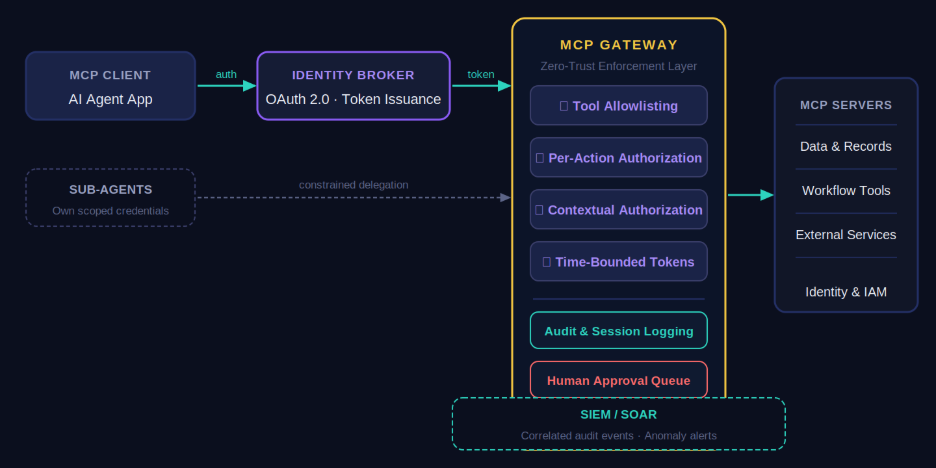
The reference architecture places the MCP Gateway as the single enforcement point for all four access control patterns. Every agent-to-tool invocation, regardless of which MCP server it targets, passes through this gateway. The gateway enforces allowlists, evaluates contextual authorization, validates token bounds, and triggers the approval queue for R4 actions before the invocation reaches any MCP server.
The Identity Broker issues time-bounded, tool-scoped tokens at session open time and handles sub-agent credential provisioning. The Agent ID Registry maintains the mapping between agent identities and their constrained permission sets — the source of truth for allowlist enforcement and constrained delegation in multi-agent pipelines.
Behavioral monitoring and audit correlation run as continuous side-channel processes against gateway telemetry, feeding real-time anomaly signals back to the contextual authorization engine and SIEM for incident response.
How AppSentinels Enforces Least Privilege Across Your MCP Environment
AppSentinels delivers the reference architecture above as a production-ready platform — purpose-built for the access control challenges unique to MCP-powered AI agent tool chains. Rather than adapting API security controls to fit agentic workflows, AppSentinels treats MCP security as an agent execution security problem from the ground up. AppSentinels offers a Business Logic Graph (BLG), which maps the expected workflow patterns for every AI agent, creating a behavioral baseline. Deviations from expected tool invocation sequences surface as anomalies for contextual authorization evaluation.
- MCP Discovery & Asset Inventory: Automatically discovers every MCP server, tool, resource, and agent connection across your environment, including shadow MCPs and undocumented tool registrations. Continuous inventory feeds the allowlisting engine.
- Tool-Level Access Governance: Enforces per-agent, per-task tool allowlists with contextual authorization signals. Blocks overpermissioned tool access at the gateway layer before invocation reaches any MCP server.
- Runtime Protection: Evaluates agent intent at invocation time — not just token validity. Detects when prompt injection has redirected an agent toward unauthorized actions, even when the tool itself is on the allowlist.
- Multi-Agent Privilege Isolation: Enforces constrained delegation across agent chains. Sub-agents operate under their own minimally-scoped credentials — parent agent permissions never propagate implicitly down the pipeline.
- Full Audit & Compliance Trail: Correlates user identity, agent decisions, tool invocations, and business outcomes into a complete, queryable audit trail — connecting every MCP action back to the human initiator for compliance and incident response.
Frequently Asked Questions
1. What is an MCP agent, and how does it differ from a traditional API integration?
2. Can prompt injection attacks bypass MCP access controls?
3. How should organizations handle MCP server tool discovery securely?
4. How do you prevent privilege escalation in multi-agent AI pipelines?
5. What is the difference between MCP authentication and MCP authorization?