

AI agents are becoming execution engines.
They do not just answer questions. They read documents, call tools, invoke APIs, update tickets, trigger workflows, send emails, approve actions, and interact with enterprise systems.
That changes the security problem.
Most agent security discussions still start with system prompts, prompt injection, jailbreaks, and model guardrails. These controls matter, but they are not enough. A system prompt is an instruction to a probabilistic model. It is not a deterministic security boundary.
Agents are designed to follow instructions. They are also designed to reason, adapt, and complete tasks. That makes them powerful and persuadable.
An agent can be influenced by a user prompt, a web page, a document, a ticket, an email, a tool response, or another agent. Some of these instructions are trusted. Many are not. And because the model is probabilistic, we cannot rely on prompt instructions alone to guarantee consistent enforcement.
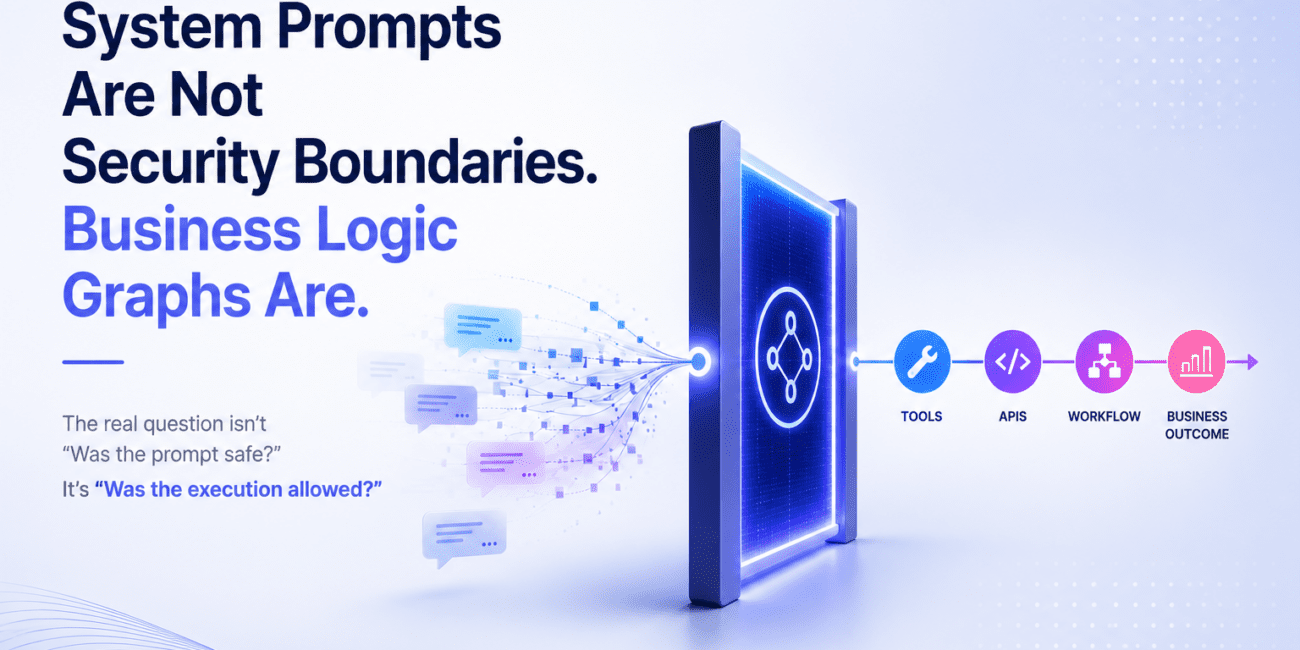
The real question is not just: “Was the prompt safe?”
The real question is: “Was the execution allowed?”
Agentic Risk Lives in the Workflow
In enterprise environments, the dangerous action is often not a single obviously malicious prompt or a malformed API call.
The risk comes when valid-looking actions combine into an invalid business outcome.
An agent may be allowed to access customer records. It may also be allowed to generate reports. It may also be allowed to send emails. But should it retrieve sensitive customer data, summarize it, and send it externally?
A finance agent may be allowed to review invoices. It may also be allowed to initiate payment workflows. But should it change vendor bank details and approve a payment in the same execution path?
An IT agent may be allowed to inspect logs, check system health, and open remediation tickets. But should it execute a privileged command without the required validation or approval step?
Each individual action may look valid. The tool may be approved. The API call may be well formed. The user may be authenticated. The agent may appear to be doing its job.
But the workflow may still be wrong.
That is the core problem with agentic AI security: the risk sits in the business logic of execution.
Why the Business Logic Graph Matters
A Business Logic Graph maps how humans, agents, tools, APIs, data, and workflows are supposed to interact.
It answers questions that prompt guardrails and static access policies cannot reliably answer:
- Who is acting: a human, agent, service, or application?
- What tools, APIs, data, and workflows are they allowed to access?
- What sequence of steps is expected for this business process?
- Which actions require approval, escalation, or additional validation?
- What outcome should this workflow produce?
- Is this execution path normal, risky, or not allowed?
This is important because access alone is not enough.
- An agent may have access to a tool but still use it in the wrong context.
- A user may have access to an API but still trigger an abnormal workflow.
- A tool call may be valid but still produce an unauthorized business outcome.
The Business Logic Graph provides the execution context needed to make those decisions.
BLG is Built Around Allowed Execution
The foundation of the Business Logic Graph is simple:
Every human and agent has business workflows they are allowed to execute — and expected ways in which they should execute them.
The graph continuously learns and maps:
- users, agents, roles, and services;
- tools, APIs, MCP servers, and connected systems;
- business workflows and expected sequences;
- permissions, constraints, approvals, and escalation points;
- sensitive data movement and transaction outcomes;
- normal and abnormal execution paths.
This creates a living model of enterprise execution.
The goal is not just to know that an API exists or that an agent has access to a tool. The goal is to know whether the action makes sense in the business workflow.
For example:
- Is the agent calling the right tool at the right stage?
- Is the API being used in the right sequence?
- Is a sensitive action happening without approval?
- Is data moving to an unexpected destination?
- Is a human or agent combining individually valid steps into an invalid outcome?
That is where real protection begins.
From AI Guardrails to Execution Guardrails
Prompt security tries to control what the model should say or refuse.
Business Logic Security controls what the human or agent is allowed to do.
That means enforcement must happen across the full execution chain:

This is especially important in MCP and tool-driven architectures. MCP expands what agents can reach. It gives agents structured access to tools, services, data, and workflows. That also expands the blast radius when execution is not governed.
The Business Logic Graph acts as the control plane for this environment.
- It helps discover what agents and tools exist.
- It maps which APIs and workflows they touch.
- It understands expected execution paths
- It detects deviations in sequence, context, permission, and outcome.
- It provides the foundation for runtime enforcement.
The Market is Aligning with this View
We are seeing more and more alignment with what we started with.
The industry conversation is moving beyond “secure the prompt” toward “secure the execution.” Agentic AI security is increasingly being understood as a workflow, tool, and business logic problem.
That is the right direction.
AI agents will not be secured only by better prompts. They will be secured by understanding what they are allowed to do, how they are expected to do it, and when execution has moved outside business boundaries.
The same foundation applies to APIs, applications, agents, MCP/tool chains, and runtime workflows. In all cases, the critical question is whether a valid-looking action is being used in the right business context.
That is exactly what the Business Logic Graph is designed to answer.
The Future is Execution-Aware Security
As agents become part of enterprise operations, organizations need more than model-level guardrails.
They need a living map of business execution.
They need to know which humans and agents are accessing which tools, APIs, and workflows. They need to understand normal execution paths. They need to detect when valid actions combine into risky outcomes. And they need the ability to allow, challenge, block, or escalate execution in real time.
System prompts will remain useful. Prompt injection defenses will remain useful. But they are not the security boundary.
The security boundary must be the business workflow.
And the foundation for that boundary is the Business Logic Graph.
Because in the agentic AI era, the most important security question is not: “Did the agent follow the prompt?”
It is: “Was the execution allowed?”
Book a demo to see how execution-aware security helps protect agentic workflows, APIs, and business logic at runtime.
Frequently Asked Questions
Why are system prompts not enough to secure AI agents?
What is business logic security in agentic AI environments?
How do AI agents increase enterprise security risk?
What is a Business Logic Graph (BLG)
Why is execution-aware security important for agentic AI?


