
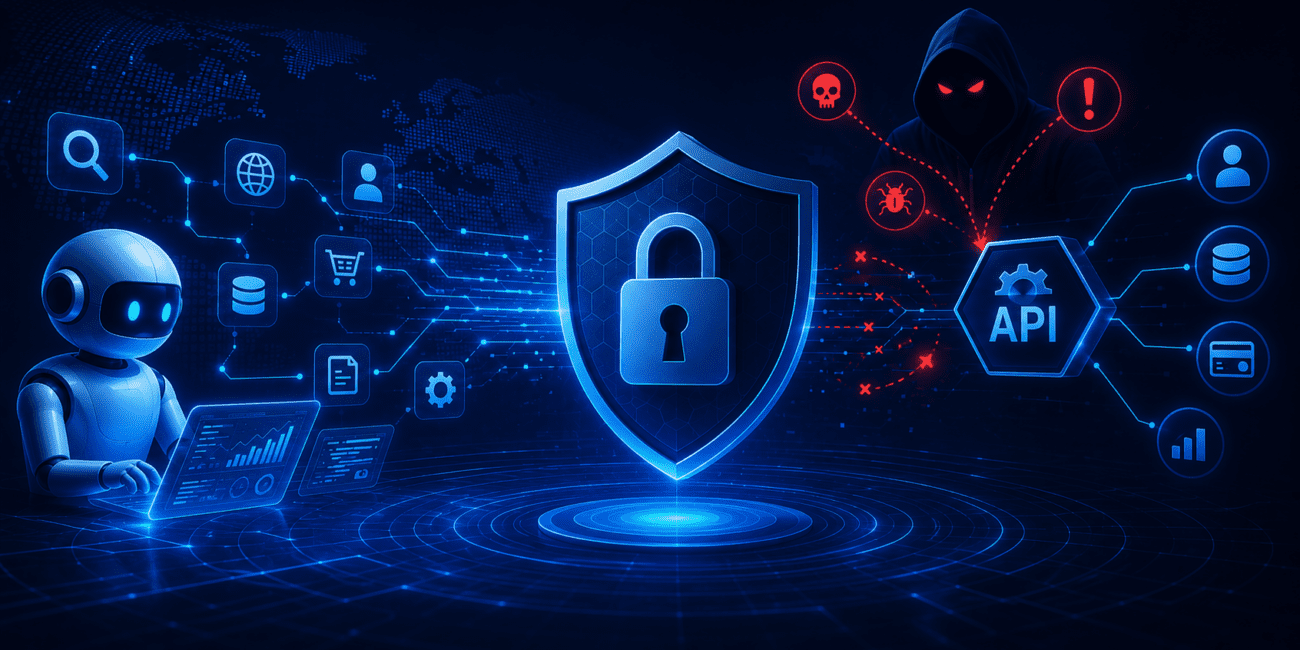

Key Takeaways
- Bots now outnumber humans online for the first time; Cloudflare confirms 57.4% of HTTP traffic is automated, driven by agentic AI.
- Autonomous AI agents call APIs at machine speed, chain workflows, and execute transactions, exposing business logic traditional security controls never see.
- The top Agentic AI threats: prompt injection, business logic abuse, identity escalation, tool poisoning via supply chain, and agent-triggered denial of service.
- AppSentinels secures the full agentic stack, mapping agent identities, MCP workflows, and API execution paths into a Business Logic Graph that enforces intent-aware guardrails in real time.
The Moment the Internet Tipped
On April 27, 2026, a threshold was crossed that the internet had never hit before. Cloudflare Radar data confirmed that automated systems, such as bots, crawlers, and autonomous AI agents, now generate 57.4% of all HTTP requests for web content. Human traffic accounts for just 42.6%.
What is accelerating this transformation is agentic AI: autonomous systems that browse, search, authenticate, and transact on behalf of users without any human intervention mid-task. In North America, the numbers are even starker: bots now generate 67.3% of all web traffic. Two out of every three requests in the world’s largest digital economy are machines talking to machines.
For security teams, it is a shift that has already happened, and most API security programs were architected for the other 42.6%.
What Autonomous Agents Do to Your APIs
A human user visiting your platform makes a handful of API calls: authenticate, load data, take action, log out. An AI agent completing the same task on a user’s behalf operates differently at a different order of magnitude.
An AI assistant answering a single user prompt may chain dozens of API calls: query an external data source, enrich the result, authenticate against a third-party tool, execute an action, and log the outcome, all before the user sees a response. Agentic systems can visit hundreds or thousands of endpoints per task where a human would visit only a handful.
According to HUMAN Security’s 2026 State of AI Traffic & Cyberthreat Benchmark Report, AI bot traffic grew 187% from January to December 2025, while human traffic grew just 3.1%. Agentic activity has been observed on checkout pages: autonomous transactions without a human in the loop. Agents authenticate on login pages. They navigate multi-step workflows. They hold sessions, maintain state, and call back repeatedly across time.
This changes everything about what API traffic looks like, what normal behavior means, and where the attack surface lives. Agents act through your APIs.
Why Agentic AI is the New Attack Surface
The security problem with agentic AI is that the infrastructure built to detect malicious behavior was designed to profile humans and agents look nothing like humans at the traffic level.
Your defenses profile humans. Agents aren’t human.
SIEMs, WAFs, and rate limiters measure anomalies relative to human baselines: request volume, session duration, geographic patterns, timing. An agent running 10,000 identical API calls in sequence registers as normal to most of these systems. But that agent may be executing an attacker’s will, systematically probing business logic, extracting data, or escalating privileges, one valid-looking request at a time.
Agents can be hijacked mid-task.
The OWASP Top 10 for Agentic Applications 2026 identifies Agent Goal Hijack as the primary threat: attackers manipulate agent objectives through prompt injection or context manipulation, redirecting legitimate capabilities toward malicious outcomes. An agent built to summarize customer data can be redirected to exfiltrate it. An agent built to file support tickets can be made to enumerate internal endpoints.
Attackers are already using agentic AI offensively.
Agentic AI hands adversaries the same capabilities it gives defenders but pointed at your infrastructure. Bad actors can now automate reconnaissance, probe API endpoints, chain API calls, test business logic abuse, and execute campaigns at machine scale. They blend legitimate API calls with malicious sequences that exploit workflows. The attack surface has expanded and so has the attacker’s toolkit.
Threat Vectors That Define the Agentic Attack Surface
These are the vectors your security program needs to account for, not as theoretical future risks, but as patterns already observed in production environments.
- Prompt Injection via API Responses: Malicious instructions embedded in data returned to an agent cause it to take unintended actions downstream. Indirect prompt injection attacks often required fewer attempts to succeed, making external data sources the primary risk vector in 2026.
- Business Logic Abuse at Machine Speed: Agents can execute complex, multi-step abuse sequences like fake account creation, referral fraud, and bulk data exfiltration faster than any rate limiter built for human traffic thresholds can catch. While the attack is valid at every step, the sequence is wrong.
- Identity & Privilege Escalation: Agents operating with excessive OAuth scopes or stolen API tokens move laterally across services at machine speed. Unlike human account takeovers, which are noisy and detectable, agent-driven privilege escalation can be methodical, low-volume, and behaviorally indistinguishable from authorized activity.
- Tool Poisoning & Supply Chain Compromise: Attackers inject malicious logic into open-source agent frameworks and tool definitions that developers download at build time. Supply chain compromises are nearly undetectable until activated, and by then, the backdoor has been in infrastructure for months, executing through every agent workflow that consumed it.
- Agent-Triggered Denial of Service: By design, agents perform multiple operations concurrently, spawning subtasks and triggering external APIs in parallel. Attackers exploit this behavior to overwhelm compute and memory, causing denial-of-service (DoS) or degraded performance without a single malformed packet in the stream.
- MCP Server Exploitation: MCP connects autonomous AI agents to enterprise tools and turns natural language into executed code, bypassing traditional firewalls. Over 15,000 MCP servers are now publicly identifiable, more than 7,000 directly internet-exposed with minimal governance, creating a rapidly expanding trust-free supply chain.
The Old Model vs. The Agentic Reality
The agentic AI security problem echoes a mistake the industry has made before. APIs were once assumed safe by default: internal, trusted, invisible to users. Security teams focused on web applications and perimeter defenses while APIs multiplied in the background. Then that assumption collapsed.
The agentic era is the same pattern, compressed. The difference is velocity. MCP-powered AI agents operate through inferred intent, dynamic tool chaining, and natural language interactions not the deterministic request-response cycles that existing security controls were built to inspect.
| Dimension | Traditional API Abuse | Agentic AI Abuse |
| Actor | Human attacker or scripted bot | Autonomous AI agent |
| Speed | Manual or scripted sequences | Machine speed, parallelized |
| Scope | Single endpoint or payload | Multi-hop, chained workflow calls |
| Behavioral signal | Anomalous volume or timing | Looks like normal, valid API usage |
| Attack layer | Network / auth bypass | Business logic exploitation |
| Detection approach | Rate limiting, IP blocking, signatures | Behavioral intent modeling required |
| Identity model | Human user or known service account | Dynamic agentic identity, tool chains |
How to Secure APIs Against Agentic Threats
Defending against agentic API threats requires a different framing. Defenders must employ real-time behavioral analytics that profile normal API usage and detect deviations, such as when an AI agent suddenly makes repetitive data-exfiltration calls. Here is what that looks like in practice.
- Establish Agent Identity: Every API caller should be treated as potentially non-human. Implement agent-specific authentication: signed requests, short-lived tokens, and agent attestation separate from human OAuth flows. Agentic identity is not the same as non-human identity (NHI), the defenses do not transfer.
- Model Behavioral Intent: Rate limiting on request counts is insufficient. You need behavioral baselines that represent what your agents are supposed to do, which workflows they invoke, in what sequence, with what data access patterns, and detect deviation from those baselines in real time.
- Enforce Business Logic Boundaries Explicitly: Every multi-step workflow your API supports, such as checkout, account creation, data export, needs explicit logic constraints that apply to non-human callers. Business logic security focuses on protecting workflows and execution paths, evaluating whether actions and sequences align with intended business processes even when individual steps appear legitimate.
- Apply Least Privilege to Agent Tool Scopes: Agents should hold only the permissions required for a specific task, for a specific duration. No persistent broad-scope API tokens. No inherited human-user permissions. Every agent capability should be explicitly scoped and time bounded.
- Protect Against Indirect Prompt Injection at the API Layer: Sanitize and validate data returned to agents from external sources before it re-enters the agent’s decision loop. Standard security blocks malicious code; MCP security must block malicious intent.
- Continuously Discover What Agents Are Calling: Shadow APIs and undocumented endpoints are invisible to agents and defenders. Continuous discovery of public APIs, shadow endpoints, AI agent APIs, and MCP-connected services is the baseline from which all other controls are built.
Securing the Full Agentic Stack with AppSentinels
AppSentinels was built to address problems where AI makes decisions and APIs execute them, and where attackers exploit the gap between those two layers. The platform unifies API security, Agentic AI security, and MCP security in a single control plane, protecting business logic end-to-end across the full lifecycle.
At the core is the Business Logic Graph (BLG), a live map of every object, ownership relationship, and access path across APIs, AI agents, and MCP workflows. The BLG continuously red-teams for missing authorization, privilege escalation chains, and intent drift, answering the only question that matters in agentic security: is this valid-looking action being used in the right business context?
- Continuous Discovery: Discover every AI agent, MCP server, tool, and execution path. Eliminate shadow APIs and blind spots before agents find them first.
- Continuous Red-Teaming: Proactively simulate workflow manipulation attacks, prompt injection, and business logic abuse before they happen in production. Like a pen-testing team running 24×7.
- Runtime Protection: Enforce real-time guardrails on AI-driven actions. Detect and block business logic attacks, API abuse, bot threats, and OWASP API/LLM Top 10 risks without breaking agent autonomy or speed.
- MCP & Agentic Workflow Security: Protect MCP servers, agent-to-tool interactions, and AI runtime flows. MCP security requires semantic guardrails that existing API controls cannot provide.
- Flexible Deployment: On-prem, cloud, or hybrid. Agent-based or agentless. Inline or out-of-band. Integrates with your existing security and DevOps stack without performance trade-offs.
Book a demo to see how AppSentinels maps every agent, MCP workflow, and API execution path, and stops threats before they reach production.
Frequently Asked Questions
1. What is agentic AI security, and why does it require a different approach than traditional API security?
2. How do autonomous AI agents create new API attack surfaces?
3. What is prompt injection in the context of agentic AI, and how does it target APIs?
4. How is agentic identity different from non-human identity (NHI), and why does it matter for API security?
5. What security frameworks and standards apply to agentic AI and API security in 2026?


